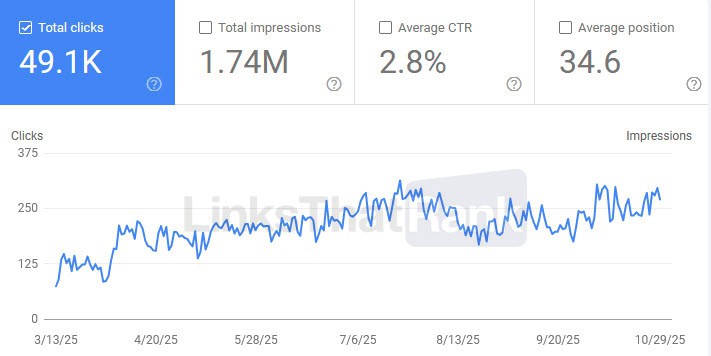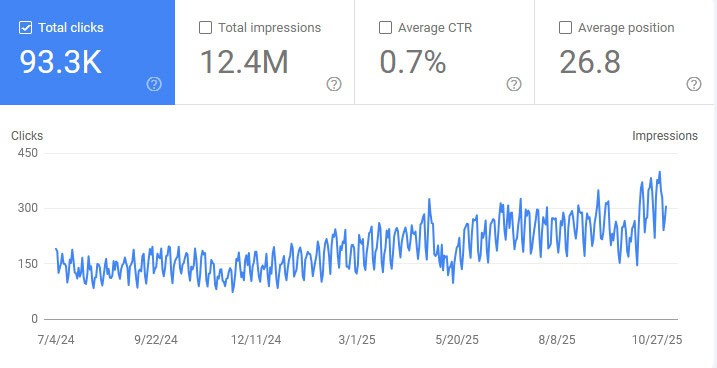

But link popularity isn’t just about volume — quality, topical relevance and authority matter more than ever.
Measure your baseline, track the metrics Google actually uses, and consistently build high-quality links to grow your rankings.
Link popularity measures the quantity and quality of backlinks linking to a specific site.

Backlinks act like endorsements for websites. The more backlinks your website has from other trusted sites, the higher you will rank.
Simple as that.
But here’s the thing…
Most websites are completely invisible to Google simply because they don’t have enough backlinks.
95% of all web pages have zero backlinks pointing at them. More than that, the top ranking position has 3.8x more backlinks than every page below.
What does that really mean?
The difference between ranking in the top position and being invisible is simply the strength of your backlink profile compared to your competitors.
That’s why I am going to explain exactly what link popularity means and how to measure yours effectively.
And at the end I’ve got the 7 proven strategies we use to increase link popularity and get more value for every link we build.

What Is Link Popularity?
Link popularity is an SEO metric that measures the quality and quantity of backlinks.
But link popularity today is way more nuanced than it used to be.
Let me explain:
Google has become very good at understanding backlink quality. That means they can quickly identify whether a link is natural and relevant to your site.
Quantity used to win. Quality wins now. That single shift is the biggest change in link building over the last decade.
It also means that link building is now a quality over quantity strategy.

Google’s algorithm evaluates:
- Total Referring Domains – The number of unique websites that link to you
- Authority of Linking Sites – A single link from a DR 50 site is worth more than five DR 10 backlinks
- Topical Relevance – Links from niche-relevant sites carry significantly more weight
- Referral Traffic – Google tracks whether users click on the backlinks to your site
- Anchor Text Distribution – The clickable text in your links should be descriptive, natural and diverse
- Surrounding Link Text – The content that surrounds your backlinks in the text
- Link Velocity – How quickly you’re acquiring or losing backlinks
Crazy, right?
The bottom line is that Google has become good at evaluating the quality of every link you build or acquire at scale.
Link popularity simply helps you measure it.
This allows you to identify links that are improving your SEO and double down on what’s working.
Why Is Link Popularity Important?
Link popularity matters because backlinks are a signal of trust for Google and AI search platforms like ChatGPT and Perplexity.
Every SEO guru on the planet tells you to build more quality links. But if you ask 10 SEOs what quality means, you’ll get 10 different answers.
That’s where link popularity comes in…
It gives you a clear framework to measure your backlinks and backlink profile as a whole.
If you can’t measure it, you can’t improve it. Link popularity is the closest thing we have to a single number that tells you whether your backlinks are doing their job.
This makes it easier to build backlinks that:
- Improve rankings
- Drive referral traffic
- Increase website authority
- Improve AI visibility
If you’re not measuring link popularity, there has never been a better time to start.
As AI search continues to grow, the quality of your links will matter more and more. Acquiring higher-quality links and measuring their effectiveness will allow you to get ahead of your competitors.
Link Popularity vs Domain Authority vs PageRank
Link Popularity, Domain Authority, and PageRank are all metrics used to evaluate individual links and your backlink profile as a whole.
Even though you’ll see them thrown around interchangeably, they differ significantly in HOW they measure backlinks.
Think of it like using different calculations and methods to accomplish the same goal.
Here’s the breakdown of each:
- Link Popularity – Think of this as a big-picture concept that describes the overall strength and profile of the links pointing to your site, not relying on any single metric.
- PageRank – Google’s own mathematical formula used to measure how important a page is based on backlinks.
- Authority – Domain Authority (DA) from Moz and Domain Rating (DR) from Ahrefs are third-party metrics that are useful benchmarks for comparing two sites.

And there is one more term you’ll regularly hear thrown into the mix – link equity.
Link equity (also called link juice) describes the authority that an individual link passes to your page.
Here’s how to think of it:
Think of link equity like the current being passed through the link. DA, DR, and PageRank are different ways of estimating the strength of that current.
Link popularity is the broader concept that gives you a bird’s eye view of the overall strength of your backlink profile, combining quantity and quality.

How Google Uses Link Popularity
Google’s use and understanding of link popularity has evolved significantly from just counting backlinks.
It measures the overall popularity of your links:
- Who is linking to you?
- How trusted are they?
- How relevant are the links?
These are the questions Google is actively trying to answer with link popularity.
Think of backlinks like a tiebreaker. When two competing pages have great content, solid on-page SEO, clean technical foundation and clear E-E-A-T, Google needs something to separate them.
That’s where backlinks come in. It’s the single factor that your competitors can’t fake, copy or steal.
And the data proves just how much backlinks matter…
Ahrefs analysed 14 billion pages and found that 96.55% of all content gets zero organic traffic.
The primary difference between the pages that ranked and the pages that didn’t?
Backlinks.
But it goes deeper than that…
A recent study from First Page Sage estimated that backlinks make up to 13% of Google’s algorithm ranking factors.
That might not sound like much. But when everything else is equal, 13% is everything. And we now have proof of exactly how Google evaluates them.
The 2024 Google leak confirmed that PageRank is very much alive internally.
Google classifies links into three quality tiers:

Click data determines which tier those links fall into. Links in the low-quality tier get completely ignored and do nothing for your rankings.
In other words, not all links are created equal.
This is why measuring link popularity is something that every website owner and SEO should be doing.
What About Link Popularity In AI Search?
Link popularity remains an essential factor in AI search tools like Perplexity, ChatGPT, Gemini and Google AI Overviews.
While AI models use other relevance and entity authority signals, backlinks are still used as a primary signal of trust.
But this is where it gets interesting…
Google AI Overviews run on a different ranking system called FastSearch. Unlike traditional search engine algorithms, it doesn’t rely on backlinks in the same way.
So does that mean backlinks don’t matter for AI search?
No, not at all. It just changes the type of backlinks you should be building.
AI search platforms rely heavily on brand mention links. Every time a trusted site mentions your brand name, it adds to the AI’s understanding of your business.
This is called entity building.
The more authoritative sites that reference your brand, the more AI tools understand:
- Who you are
- What you do
- Why you should be trusted
- Who you serve
Those factors are what get you cited and recommended in AI answers.

That’s why link popularity still matters in AI search. It measures the authority of brands mentioning you, which can drive more AI search visibility.

How To Measure Your Link Popularity Accurately
Measuring link popularity doesn’t just come down to individual metrics and the total number of links.
It’s about combining multiple metrics together to understand the overall strength of your backlink profile. Think of them like essential KPIs that reveal exactly where the gaps are.
Follow these steps to measure your link popularity and see how you stack up against competitors.
1. Check Your Baseline With Free Tools
To get your baseline of link popularity, start with Google Search Console.
It gives you a good overview of your backlinks and the types of sites you’ve got linking to you.
Log in to GSC, click on the Links report to see all of your external links.

Here’s what you want to look at:
- External domains that have linked to you
- Top linking sites
- Most common anchor text
This will give you an idea of the types of sites that link to you and how strong your overall backlink profile is.
Done that?
Next, create a free account on Ahrefs and add your website.
Here you’ll be able to see your:
- Domain Rating
- Total backlinks
- Number of referring domains
- Specific linking pages
The good thing about Ahrefs is that the DR authority score helps you quantify your authority. It gives you a baseline that you can use to compare against competitors.
2. Track the Metrics That Actually Matter
Now that you have your baseline, you need to know which numbers actually move the needle in terms of backlinks and rankings.
Here are the metrics that actually matter for link popularity.
Referring Domains
Look at how many unique websites link to you.
Think of referring domains as your link popularity baseline.
A site with 500 referring domains has a broader popularity than a site with 40 referring domains. The same is true for a site that has 10 referring domains compared to a site that has 40 backlinks from the same referring domain.
Referring domains are your base metric for your link popularity.
The more you have, the more “popular” your site is. But as you already know…
It’s not just about quantity. Quality of the links matters more.
1 link from a DR 60 site can outweigh 50 links from DR 10 sites. Always prioritise quality over volume.
Linking Site Organic Traffic
Organic traffic might be the most underrated link popularity metric.
Why?
Because if Google sends organic traffic to a website, you can be confident that Google trusts that site.
A backlink from a trusted site is worth way more than 10 backlinks from sites with no organic traffic. That’s why it needs to be part of your link popularity equation.
Here’s what you do:
Look at how many referring domains have 500+ monthly organic visitors. This is the baseline that shows Google trusts a site.
Use the Domain Traffic filter in Ahrefs to make this easy.

This is your quality referring domain count.
Topical Relevance
Topical relevance to your site is very important, even if the site meets the minimum traffic threshold.
A link from a trusted site in your niche that covers similar topics carries more weight than a link from a generic site. Google wants to see that your website is recognised and trusted in your industry.
Here’s how to look at it:
Pull up your backlink profile in Ahrefs.

Click on each backlink:
- Is the link placed in topically relevant content?
- Does the site regularly cover similar topics?
A healthy link popularity profile means the majority of your links come from topically relevant sites. In our experience, 70% or more of sites linking to you should be topically relevant.
If it’s below that, you need to focus on building more relevant backlinks.
Anchor Text Profile
Think of anchor text as a signal that tells Google why the site is linking to you.
The mix of anchor text across your backlink profile tells Google whether your backlink profile is natural or manufactured.
Anchor text is the closest thing Google gets to a direct vote on what your page is about. Get the mix wrong and you signal manipulation.
How do you know what a good anchor text profile looks like?
It depends on your competitors and industry.
A natural anchor text profile should have a mix of anchors:
- Exact Match
- Topical
- Brand
- URL
- Generic
Use Ahrefs to look at your anchor text profile.

Record the percentage of each anchor type in a spreadsheet.
Now, take your top 5 competitors and do the same analysis of their anchor text profile.
The last step is to calculate the average of each anchor type from your competitors and compare it to your own profile.
For example, you might find that your competitors’ brand anchors make up 30% of their anchor text profile while yours is 15%. This simply means you need to build more links with branded anchor text.
Simple, right?
Follow this anchor text process to learn more.
Getting your anchor text profile right is important to increase your link popularity. Anchor text that looks natural to Google will mean your backlinks have a stronger effect on your rankings.
3. Compare With The Competition
Your own link popularity metrics only tell half the story.
The other half is simply how your site stacks up against websites ranking above you.
Google ranks pages relative to each other. That means your link popularity doesn’t need to be perfect – it just needs to be better than the competition.
Here’s how to find that gap:
Use the Ahrefs Link Intersect tool to find domains that link to your competitors, but not you.

These are the low-hanging fruit. If the site links to one or two of your competitors, it’s also likely to link to you.
All you have to do is replicate the link by reaching out to the site.
For example, if your competitor got the link through a guest post, pitch a guest post. If they got it through a data point or statistic, provide your own.
You get the picture.
Closing the gap between your referring domains and your competitors will boost your own link popularity. That means higher rankings and more traffic.

Recommended Tool Stack
You don’t need a lot of tools to measure and understand your link popularity.
But there are a few free and paid ones you need to consider.
Paid Tools:
• Ahrefs - Best overall tool for backlink analysis, DR scoring and measuring link popularity
• Semrush - Strong competitor analysis with Authority Score

Free Tools:
• Google Search Console - Provides a complete list of all linking domains
• Ahrefs Website Authority Checker - Quick DR and backlink overview
• LinksThatRank Backlink Blacklist - Check if your links are on known PBNs, spam domains or link farms

7 Proven Strategies to Increase Your Link Popularity
93.8% of all link builders say that quality is more important than quantity.
Below are 7 proven strategies that help you build quality backlinks that increase link popularity.

1. Create Linkable Assets With Original Data
Original data is one of the most powerful ways to earn backlinks.
Why?
Because you do the survey, collect the data and publish. No one else has that data. It’s uniquely yours.
This makes you the primary source.
When journalists, writers and bloggers need data to back up their points, they link to your linkable asset as the source. That means you can earn massively powerful and relevant backlinks from major publications.
Linkable assets with original data are one of the few link building strategies that earn quality links passively that you’d never otherwise be able to build.
Here’s what you need to do:
Start by finding an interesting angle around your niche.
Think about:
- What assumptions can you test?
- What questions does your audience ask?
- What’s a common issue you see regularly?
You’re going to create a survey that collects data. So you need an angle that people want to know more about.
Got your topic?
Ask ChatGPT to design an 8-10 question survey around the topic. Questions that will grab people's attention and will generate headline-ready findings journalists want to cite.
Then run a survey using a tool like Google Forms or SurveyMonkey. Aim for 300+ responses to your survey to ensure it’s statistically relevant data.
Don’t have an audience?
Use a platform like PollFish to collect responses. Typically, you’ll pay about $0.80 and $1.00 per response.
Now for the important part…
Once you’ve collected the data, you need to publish it. Publish all questions and answers in a post.
Add:
- Graphs
- Charts
- Tables
To display your data visually. Create an infographic with the essential data points and findings at the top of the post. This makes it instantly shareable.
Write a short introduction with your biggest 2-3 findings.
This will hook readers and draw them in.
Publish the post, share it on your social media channels and send it to your email list. Over time, you’ll start to see journalists, writers, and bloggers linking to the post as they use the data in their articles.
This means your linkable asset will become a passive link magnet, earning quality, relevant backlinks long after it’s published.
2. Build Links Through Strategic Guest Posts
Guest posts are one of the most proven and effective ways to build high-quality backlinks.
And for good reason…
When you publish a guest post on another website, you’re essentially borrowing some of their authority in the form of link equity. But more importantly, you have complete control over the quality of the links.
This means you control the:
- Guest post topic
- Content quality
- Link placement
- Anchor text
- Surrounding text
This level of control is rare in link building. And it’s why strategic guest posts are one of the top link building strategies.
But here’s the thing…
Not all guest posts are created equal. The quality of the site you choose has a massive impact on how effective the guest post link is on your rankings.
A guest post on a low-traffic, irrelevant site does very little for your rankings. It can actually have a negative impact on your link popularity.
That means you need to select sites that:
- Have 500+ monthly organic visitors
- Post similar content to your niche
- Have high editorial standards
- Regularly publish quality content

Don’t have time for all that?
LinksThatRank builds done-for-you guest posts on real sites with real traffic.
Every link we build passes our strict 23-point quality control process and is manually reviewed by a member of our team before being published live.
That means you only get quality backlinks to move your rankings forward and help you get recommended in AI search.

Choose the links you need and tell us your target keywords – we’ll take care of the rest.
3. Claim Unlinked Brand Mentions
This is one of the easiest link building strategies that every website owner should be taking advantage of.
It helps increase link popularity, improves your Google rankings and can lead to citations in AI search answers.
Who doesn’t want that, right?
Here’s how it works:
You find mentions of your brand online where the website owner or author has mentioned your brand, but hasn’t added a link to your site. All you have to do is reach out and let them know.
The reason this works is that the website already knows who you are and trusts you enough to mention you. They just didn’t add the link.
How do you find unlinked brand mentions?
Use the following search operators:
"your brand name" -site:yourwebsite.com
"your brand name" -site:yourwebsite.com -site:x.com -site:facebook.com -site:linkedin.com -site:instagram.com
"your product name" -site:yourwebsite.com
"your brand name" "according to" -site:yourwebsite.com

This will bring up mentions of your brand online, excluding any mentions of your site and social media sites.
All you have to do is comb through the results and look for unlinked mentions of your brand.
It might take you a few clicks before you find one. That’s totally normal and just part of the process.
What about future unlinked mentions?
Set up a Google alert for your brand.

Each time you get a mention online, you’ll be alerted by Google.
It takes just a few seconds to click and ensure that the mention is linked. If it’s unlinked, you can immediately reach out to the writer or site owner and ask whether they would mind adding it in.
4. Use Broken Link Building
66.5% of links built in the last nine years are now dead.
Why?
Content gets moved, pages get deleted, and people forget to redirect URLs.
Broken link building gives you an opportunity to clean up the web while also netting yourself some handy links.
Broken link building converts at 5-10x the rate of cold outreach. The site owner already has an incentive to fix the dead link — you're giving them the solution.
All you have to do is identify broken links on relevant sites. Then reach out to let them know and offer one of your pages as a replacement link to fix it.
Simple, right?
You have two options: Check My Links (free) or Ahrefs (paid).
If you’re serious about broken link building, then I recommend Ahrefs. It has a built-in tool to make this whole process super easy.
All you have to do is enter your competitor’s domain into Ahrefs and click the Best by Links report.

Then filter by 404 pages and sort by referring domains, highest to lowest.

What you’ll see is a list of pages pointing to now broken links on your competitor’s site.
Comb through the list and search for each broken URL on Wayback Machine.

This will show you exactly what content used to be on the broken page. Head over to your site and see if you have a similar piece of content to offer as a replacement.
Found one?
Reach out to the site owner and let them know about the broken link on their site. Offer yours as a replacement and make it as easy as possible for them to add it.
What if you don’t have a relevant replacement?
This is where you’ll have to make a decision. You could choose to create one and then reach out. It depends on how likely you think it is that you’ll win the link with your new content.
If not, just move on.
There are plenty more links in the sea.
5. Earn Links Through Digital PR
Google’s John Mueller has publicly endorsed digital PR, saying it’s:
“Just as critical as tech SEO, probably more so in many cases.”
That’s about as close to a direct endorsement as you’ll get from Google.
The best thing is that digital PR is actually straightforward. Journalists need sources for their articles.
They often rely on quotations and information from real experts to cite as sources in their articles. When they list someone as a source, they’ll go back to the source’s website.
That means you can earn powerful links from major media publishers like the New York Times, USA Today and Forbes.
Here’s what you need to do:
Sign up for these 3 sites now: Sources of Sources, Featured.com, and Qwoted.

They all work very similarly. Journalists will publish questions or request expert information on each of the sites.
When a topic comes up that you are a genuine expert in, you can reply with your opinion and contact information.
If the journalists use your reply in their article, they’ll often link to your site as the source.
Simple, right?
Digital PR provides you with an opportunity to build quality links from major publications. It helps build the popularity of your backlink profile as a whole.
And digital PR links have been proven to boost both traditional Google rankings and AI search citations.
6. Get Link Inserts in Existing Content
Link Inserts (also called niche edits) involve getting your link placed into existing published content that’s already indexed on Google.
Why does that matter?
Think of it like this…
A brand new guest post link can take weeks for Google to find, crawl and index. An aged piece of content is already indexed and trusted by Google.
That means a link insert inherits trust and authority the moment it goes live. That’s why link inserts typically have a faster impact on your rankings.
Three advantages of link inserts:
• The content is already aged and trusted
• Links get indexed by Google faster
• You skip the content creation process
To build them, you simply need to find relevant articles on relevant sites that your link would naturally fit into.
Start by searching for your target keyword on Google and opening the first 30-40 ranking results on Google.

For each page, ask yourself one simple question – Is there a natural place for my link in this content?
If the answer is yes, add it to your outreach list.
You can also try related keywords and relevant questions to find potential link insert opportunities.
Then simply reach out to each website owner on your list. Explain why your link would be a natural fit and beneficial to their content. You can also offer to add an extra benefit, like promoting their site on your email list or sharing the article on your social media.
This will increase conversion rates.
Sounds simple, right?
The truth is that you will need to spend a lot of time researching and finding quality outreach prospects. Link inserts typically convert at less than 2%. That means you’ll need to send at least 100 link requests to convert a couple of links.
And that’s if you do a good job!
That’s why so many business owners and even SEO agencies choose to outsource.
Don’t have time?
LinksThatRank link insert services earn you quality backlinks in aged articles (at least 12+ months) on real sites with real traffic. Most link inserts are delivered within 14-21 days and pass our strict 23-point quality control review.

Choose the links you need, tell us your target keywords, and we’ll find the perfect placements for your brand.
7. Replicate Your Competitors’ Best Links
Your competitors have already done the hard work for you.
Think about it like this…
Every link pointing to a competitor’s site is proof that the site is willing to link to content in your niche. That means if they link to your competitors, there’s a good chance they’ll link to you too.
All you have to do is find those links and replicate them.
Here’s what to do:
Create a list of your top 5 SEO competitors.
Open Ahrefs, enter the first competitor’s domain and select the Backlinks report.

Apply the following filters:
• Dofollow
• Link-type: In-content
• Minimum DR: 20
Now you have a complete list of all your competitors’ backlinks that are actually driving rankings in Google and AI search. Export the results as a CSV file.
Rinse and repeat for each of your competitors.
Now you have hundreds of potential link opportunities. But here’s where the strategy really pays off…
Go through the list of backlinks and ask yourself one question for each link: Why did this site link to my competitor?
Was it a guest post? Pitch your own guest posts. Was it a resource page? Ask to be listed. Was it a statistic reference? Create your own data and offer it.
You get the point.
Once you understand how and why the link was earned, replicating it is straightforward. You simply do exactly what your competitors have done.
Replicating your competitors’ backlinks is one of the most efficient link building strategies. And because you’ve added the filters, you know that you’re only building quality links that improve your link popularity.
Link Popularity Mistakes That Will Tank Your Rankings
Now you understand how to increase your link popularity, and you’ve got a list of proven strategies to do it.
Before you start taking advantage of those strategies, I want to show some of the most common link popularity mistakes I see all the time.
Avoid each of these at all costs.

Buying Cheap Links
Cheap links look attractive because they offer high DR backlinks for lower prices.
Don’t get caught in this trap.
Sites that offer cheap backlinks often artificially inflate their domain authority to appear higher than it is. These sites are usually part of private blog networks with very little real-world value.
If the price seems too good to be true for the DR offered, the metrics have been gamed. Google’s algorithm sees straight through inflated authority scores.
The truth is that Google can spot these links from a mile away. Google will simply ignore them, which means you waste your link building budget or in the worst case…
You could be hit with a penalty. It’s just not worth the risk.
Using Private Blog Networks
Private Blog Networks (PBNs) worked back in the early 2000s to about 2014.
They were simply networks of sites that would link to each other to increase the perceived domain authority.
Let me be clear:
PBNs do not work today. Google has launched a series of spam updates over the last decade that have made PBNs a risky black-hat SEO strategy.
Before you build a link, check it on our LinksThatRank Backlink Blacklist. It has over 60,000+ blacklisted domains consisting of PBNs, link farms and sites with write for us pages.

Over-Optimising Anchor Text
This is one mistake that I constantly see made by both SEOs and website owners.
They only use exact match anchor text. This is the fastest way to earn an anchor text penalty and destroy your rankings.
A natural anchor text profile consists of a mix of:
- Exact match
- Topical
- Branded
- URL
- Generic

Google actively looks for patterns of keyword stuffing to identify over-optimised anchors. Make sure yours looks natural to improve your overall link popularity.
If you need help, check our anchor text selection guide.
Ignoring Topical Relevance
Topical relevance is an extremely underrated part of link building.
And the 2024 Google algorithm leak showed us that Google is very good at understanding topical relevance.
A law firm earning a backlink from a tech blog will have very little ranking value compared to earning a link from a legal publication.
Ensure that you only build highly relevant links from relevant pages on sites that regularly publish content about topics similar to your niche.
Never Auditing Your Backlink Profile
Toxic links accumulate over time.
One toxic link probably won’t hurt you. Fifty of them quietly poisoning your profile for two years almost certainly will.
Each quarter, run a backlink audit using Ahrefs or Semrush. Watch out for links from pages with thousands of outgoing links, de-indexed pages and a list of sites for content.

It takes less than 20 minutes to do and can significantly improve your link popularity.
Wrapping It Up
Link popularity is important for determining where your site ranks in Google and AI search tools.
The good news is that it’s measurable and completely within your control to improve.
Start by getting a baseline and understanding your current link popularity. Then focus on building high-quality backlinks that increase your link popularity.
Don’t use all 7 strategies at once. Just pick one or two that make the most sense to you and work at them until you start seeing results.
Actively track the quality metrics for each link you build. This will help you understand what links are driving the biggest results for your site.
Don’t have time to build quality links yourself?
At LinksThatRank, we only build high-quality backlinks that boost SEO rankings. Our links are built to the highest standards and designed to help your site rank in both traditional Google search and the AI search results.
Choose the links you need or order one of our custom link building packages.
- Guest Posts – High-quality AI search-ready
- Link Building Packages – Discounted monthly bundles
- Link Inserts – Niche-relevant editorial placements
- Agency Program – Discounted white label services
Frequently Asked Questions
Is link popularity still a Google ranking factor today?
Yes, link popularity is still a strong ranking factor for Google. It actively measures the quality of your backlink profile, not just the quantity. While AI search has changed SEO, link popularity still plays an important part in being recommended and cited in AI answers.
How many backlinks do I need to rank on page one?
There is no magic number of backlinks you need to rank on page one. It depends on your current site authority, the target keyword and the level of competition. The easiest way to calculate how many backlinks you need to rank is to look at the top three ranking pages. This will help you understand the backlink gap.
What’s the difference between link popularity and Domain Authority?
Link popularity is the overall concept that measures the quality and quantity of your backlink profile. Domain Authority (Moz) and Domain Rating (Ahrefs) are third-party metrics that attempt to quantify link popularity on a logarithmic scale of 0-100. They are both useful benchmarks measuring your backlink profile and how you stack up against competitors.
Does link popularity affect AI search visibility?
Yes, link popularity can affect your AI search visibility. Sites with a strong, natural and highly relevant backlink profile get more visibility in AI search. Backlinks also help you rank higher in traditional search, which means AI LLMs are more likely to find your site and reference it.
How long does it take for new backlinks to affect rankings?
New quality backlinks take anywhere from 4 to 12 weeks before they affect rankings. Our clients typically see the impact of new links within 6 weeks. Link inserts tend to have a faster impact than guest posts, because they’re placed into aged content that’s already indexed and trusted by Google.