
But most businesses measure it too early, use the wrong metrics or don’t measure it at all. The average ROI from SEO is 748%, but you need the right formula for your business model.
This guide shows you exactly how to calculate SEO ROI correctly in 2026, measure link building returns with the Lifetime Link Value formula and avoid the five mistakes that wreck your numbers.
SEO ROI measures how much money you make from SEO compared to what you spend on it.
The standard SEO ROI formula is: (Revenue from SEO – Cost of SEO) / Cost of SEO x 100.
It answers that simple question every business owner asks – “Is SEO actually working?”
Sounds simple, right? But in practice, it’s actually harder than you think.
Because most businesses measure SEO ROI:
• Too early
• Using the wrong metrics
• Or not at all
And that’s a serious problem. If you don’t measure SEO returns correctly, you can’t make good decisions.

The average ROI from SEO is 748%. Which means for each $1 you invest in SEO, on average, you get $7.48 back. Who wouldn’t make that investment?
But SEO isn’t like any other marketing strategy. The returns build slowly, compound over time and keep paying you back long after the initial work is done.
With that in mind, let me show you how to calculate ROI correctly, what good results actually look like and whether your SEO is paying off.

The SEO ROI Formula (And How To Use It)
This is the SEO ROI formula:
SEO ROI (%) = (Revenue from SEO - Cost of SEO) / Cost of SEO x 100

For example, let’s say that you spent $25k and made $100k. The formula would look like this:
($100k – $25k) / $25k x 100 = 300%.
In other words, the ROI of this example campaign is 300%, which means for every $1 spent on SEO the return was $3 in revenue.
Simple, right?
The difficult part is figuring out exactly what constitutes an “SEO cost” and how to track the amount of money you made from SEO exclusively.
What Counts As An SEO Cost?
An SEO cost is everything you directly spend on organic search traffic.
This can include:
• Agency fees
• Freelancer retainers
• In-house SEO salaries
• Outsourcing link building
• Tool subscriptions
And more. The key here is the word “directly”.
Let me explain:
Let’s say you decided to upgrade your website hosting provider to improve your overall website infrastructure and create a better-looking website.
As an indirect result, it also increased website speed, which improved your user experience and led to a boost in rankings.
Is this a direct SEO cost?
No. The intention was to improve your website. The SEO benefit is a side effect, not the goal. So it’s not included in your calculation.
The bottom line is that if you can’t draw a straight line from the spend to the SEO strategy, it doesn’t belong in your SEO cost calculation.
What Is SEO Revenue?
SEO revenue is any revenue that your business generates directly and only from organic search traffic.
This is where the rubber meets the road.

SEO revenue shifts the focus from soft metrics like:
- Rankings
- Traffic
- Visibility
And moves over to tangible business metrics like:
- Conversion rate
- Leads
- Sales
Most business owners think of SEO traffic as only traffic from Google. While Google has always been (and still is) the number one organic traffic generator, the SEO world is changing quickly.
SEO has expanded beyond traditional search engines to include AI platforms like Perplexity, ChatGPT, Gemini, AI Overviews, Claude and Grok. This is all part of organic search now and needs to be included in your revenue calculation.
How do you do that?
Analytics tools like Google Analytics simplify everything. They group traffic from all of these sources into one category – “organic”.
That means you don’t need to track each platform individually to calculate your SEO revenue and ultimately your ROI.
Here’s the bottom line:
If someone found your business through any source of organic search and converted into a sale, that’s SEO revenue.

How To Calculate SEO ROI For Your Business Model
Here’s where it gets tricky…
Not every business sells products online with a clean customer journey. So revenue looks different depending on your business model.
The important part is to set up the right tracking system for your business so you can accurately calculate the SEO ROI. Here’s how you do it for each business model.

1. Ecommerce
Do you sell products online?

This is the most straightforward calculation for SEO ROI. Most ecommerce platforms like Shopify and BigCommerce track purchases and the source of traffic for those purchases.
You can also integrate Google Analytics with your ecommerce platform to track everything accurately.
Here’s an example:
You invested $3k/month into SEO, and Shopify shows you made $14k/month in revenue from all your organic traffic sources.

Your ROI formula is – ($14k – $3k) / $3k x 100 = 367%.
Makes sense, right?
It’s easy to track where the traffic came from, how much revenue you made and your overall ROI.
2. B2B / Lead Generation
B2B is a little bit trickier because a form submission lead isn’t revenue.

What do you do?
The key is knowing how much each lead is worth to your business revenue on average.
Let’s break it down…
Imagine you have a 20% lead-to-sale conversion rate. That means for every 10 leads you get, 2 of them turn into paying customers.
Next, calculate your average customer lifetime value (CLV). This is calculated by multiplying your average transaction value by the average number of transactions.
For example, you run a services company that charges $2,000 per month, and the average customer stays for 7 months. Your average customer lifetime value (CLV) is 7 months x $2,000 per month = $14,000.
Now you can assign a value to each lead you get.
In my example, each lead is worth $14,000 CLV x 20% conversion rate = $2,800.

In other words, the average amount of money each lead is worth to your business revenue is $2,800.
Now you can calculate your ROI.
If you generate 20 leads from organic traffic each month and spend $8,000 per month on SEO services, the formula looks like this:
(20 leads x $2,800 avg. lead value – $8,000 SEO costs) / $8,000 SEO costs x 100 = 600% ROI.
Cool, right?
The most important number for B2B companies is your lead value. Once you know that, the rest falls into place.
3. Local Businesses
Local businesses often find it hard to track online purchases.
But that doesn’t mean that SEO isn’t driving revenue.
The majority of local businesses make most of their sales through:
• Phone calls
• Lead forms
• Walk-ins
That makes tracking SEO ROI harder, but not impossible.

Let me show you how to do it…
The most important part is to track every inbound enquiry that comes from organic search and assign an accurate value to it.
Here’s a simple example:
You run a local plumbing business.
From organic search, each month you get:
• 15 phone calls
• 10 lead form submissions

That's a total of 25 organic enquiries. You close 65% of enquiries at an average job revenue of $400.

That means:
25 enquiries x 65% close rate x $400 avg. job revenue = $6,500 in SEO revenue.
If your SEO costs $1,500/month, the ROI formula is:
($6,500 – $1,500) / $1,500 x 100 = 333% ROI
You might be thinking, how do I track phone calls?
Use a tool like CallRail to track each phone call you get from your Google Business Profile listing and your website. Then, integrate CallRail with Google Analytics.
That will turn previously invisible phone call enquiries into trackable revenue.
4. The Traffic Value Method
If your business doesn’t fit into the other three categories…
The traffic value method is the way to go.
The goal is to assign an accurate revenue value to each visitor you get to your site.
Here’s how to do it:
Quality tools like Ahrefs and Semrush have a “traffic value” metric built in.

It calculates what your current organic traffic would cost if you had to buy the clicks through Google Ads.
For example, if your site gets 4,000 visitors per month and the average cost per click (CPC) is $3.20, your traffic value is $12,800.

If your SEO costs $2,500 per month, the ROI formula is simple:

($12,800 - $2,500) / $2,500 x 100 = 412% ROI
Is the traffic value method completely accurate? No. Is it good enough to make the right investment decision? Absolutely.
And that’s what matters most at the end of the day.
If you can’t use any of the previous methods to calculate your ROI on your SEO campaign, the traffic value method is your next best option.
Pro Tip: Use the traffic value method to justify SEO investment to stakeholders or potential clients who think in PPC terms. Giving them a specific value of organic traffic helps your point land clearly.

The ROI Of Link Building
One of the most important investments you can make in your SEO is link building.
SEO agencies spend 32.1% of their entire client campaign on link building alone. That's a big chunk and absolutely worth calculating your ROI on.

Why spend so much?
Short answer: It works.
9 out of 10 website owners see ranking improvements from link building within the first 6 months. More than that, link building is one of the core strategies for being mentioned in AI Overviews.
The reality is that link building is an SEO investment that keeps on compounding.
A link you pay for today will still be working for your business 12+ months from now.
How To Calculate Your Link Building ROI
The framework we use for calculating Link Building ROI is called the Lifetime Link Value.
It’s the best way to calculate your ROI for link building specifically. And it works just as well for SEO agencies as it does for businesses.

This is the link building ROI formula:
(Traffic Value / Total Linking Root Domains) x 24 months = Lifetime Link Value
Here’s what each part of the formula means:
- Traffic Value – What your current organic traffic would cost if you had to buy it through Google Ads.
- Total Linking Root Domains – The number of total unique websites linking to your page.
- 24 Months – Estimated time the average backlink passes link equity, although it can be much longer.
In most cases you calculate the Lifetime Link Value based on individual pages.
Take a look at this example…
Your competitor's page has:
• A traffic value of $7,000/month
• 103 linking root domains

The calculation looks like this:
($7,000 / 103) x 24 = $1,631 Lifetime Link Value
That means each link pointing to that page is worth $1,631 over its lifetime.
Crazy, right?
This is how every agency, SEO freelancer and business owner should think when investing in link building services.
It tells you the maximum amount you should spend to acquire a single, relevant, high-quality link to maintain a positive ROI for that specific page.
If the cost to acquire a link is less than the value it provides to the page, it’s worthwhile.

Pro Tip: Want to skip the headache of building links yourself? Let our specialised team at LinksThatRank build them for you. Every link we build is placed on a real site trusted by Google, passes our strict 23-point quality control process and is designed to pass maximum link equity.
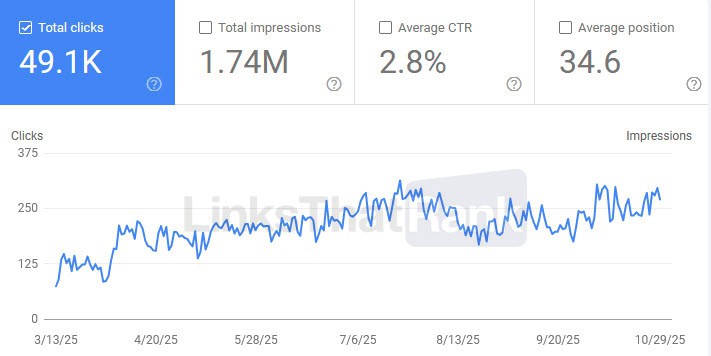
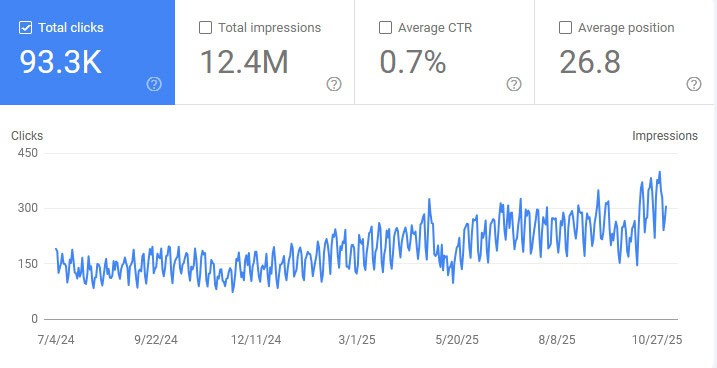
Our proven link building process delivers results like this:

Start building links that actually help you rank. Order here.

How AI Search Changes SEO ROI
If you’re still measuring your SEO ROI like a couple of years ago, your numbers are probably wrong.

Here’s why:
Google AI Overviews now reach over 2 billion people every month and ChatGPT has more than 1 billion active weekly users. More than that, 38% of people now use AI regularly for searching online.
And that’s not even mentioning the fact that traffic from AI tools like ChatGPT, Perplexity and Gemini converts 4.4x better than traditional Google traffic.

Why does all this matter?
You need to track beyond clicks from traditional search engines like Google.
Because if someone finds your business through a ChatGPT recommendation, Perplexity search or as a source in an AI Overview – that’s still SEO revenue.
If it’s not part of your calculation, you’re not counting accurately.
That means tracking things like:
• AI search visibility and mentions
• Traffic from AI search tools
• Branded mentions
• Conversions by source
The good news is that you can track all of this relatively easily through Google Analytics for free.

If your traffic is flat but your conversions are up, your SEO is working.
Measuring organic traffic, rankings and clicks is still important. But you need to be aware that there are new SEO metrics that paint the whole picture.
The businesses that are truly understanding their SEO ROI right now aren’t just tracking Google clicks anymore. They’re tracking everything.

5 Mistakes That Can Wreck Your SEO ROI Numbers
By now you should have a good idea of how to accurately calculate and measure your SEO ROI.
But I want to show you the most common mistakes to avoid when calculating your return.

1. The Attribution Problem
This is the biggest mistake and hardest to solve.
Here’s the problem:
It’s not uncommon for someone to discover your business through organic search, leave and come back another way.
For example, a user sees your business on Google, visits your site and leaves. A week later they come back directly by typing in your domain and then convert as a lead.
Google Analytics will attribute this lead to “direct” traffic, not organic search. When you go to calculate your SEO ROI, it looks worse than it actually is.
See the problem?
This is typically a bigger issue for businesses that have a longer sales cycle or require more touchpoints before a customer converts.
But the big question is…
How do you solve this?
The solution is to switch the attribution model in Google Analytics from “Last-click” to “Data-driven”.

This essentially spreads the credit across every touchpoint of the customer journey and gives you a more accurate picture of your marketing channels.
But don’t stop there…
Once you’ve got the data-driven attribution set up, use the key event attribution path report to see how often organic search plays a role in your customer journey.
You can even take it a step further by increasing the attribution window from 30 to 90 days.
The bottom line is that if you’re using last-click attribution, you’re not getting an accurate picture of how your SEO campaign is impacting your business.
That makes it very difficult to calculate your SEO ROI.
2. The Timeline Problem
This is one of the biggest mistakes I see businesses and even SEO agencies make…
…Evaluating SEO ROI too early.
Measuring your ROI at month 3 is like judging a retirement fund after the first quarter. It just doesn’t make sense.

At the same time, measuring SEO purely on a monthly basis also doesn’t make sense. Searches can be seasonal, which can impact the amount of traffic and conversions you get from organic search.
Here is what a realistic SEO campaign timeline actually looks like:
• Month 1-3: Technical fixes, content creation and initial link building with little to no movement in rankings
• Months 3-6: Rankings start to move and small gains in traffic
• Months 6-12: Significant ranking improvements, growth in AI visibility and noticeably more conversions from organic search
• Months 12+: Full ROI potential, stabilised consistent growth and organic revenue starts to compound
What does all this mean?
You must wait at least 9-12 months before you even consider measuring your SEO ROI and making budget decisions. Any earlier and you’re essentially guessing.
Remember:
SEO is a long-term growth strategy that compounds over time. Don’t try to measure your returns too early.
3. The Brand vs. Non-Brand Problem

Searches can be broken down into two types:
- Branded – Searches related to your brand name or business.
- Non-branded – Searches for high-value keywords that aren’t directly related to your brand name.
The issue is that most businesses lump all organic search traffic together.
Why does this matter?
Because branded traffic and non-branded traffic should be treated differently.
If someone searches “Nike”, they already know the brand and are just using Google as a navigational tool to get to the site. They’re going to find Nike with or without any SEO effort.
But if someone searches “best running shoes for flat feet” and Nike ranks for this search, that’s a completely different story. They found Nike as an option purely because of the SEO strategy.
The bottom line is that you need to filter out your branded traffic when calculating SEO ROI.
If your site gets 10,000 visitors per month and 4,000 of them are searching for your brand, then only 6,000 are actually driven by the SEO campaign. Including the branded traffic with the non-branded traffic leads to an inflated ROI calculation.
Get this wrong, and your ROI numbers are essentially meaningless.
How do you fix it?
The easiest way is to use Google Search Console to filter out the branded searches.
Here’s how to do it:
Log in to Google Search Console, click the Performance tab, select Add Filter and choose Query.

Select Custom (regex) and choose Doesn’t match regex

Now, use the following expression regex:
(YourBrandName|Your Brand Name)
Just replace “Your Brand Name” with your actual brand name, and you’re done.
This will filter out all of the branded searches and give you an idea of clicks only from non-branded keywords that your SEO campaign actually affects.
Cool, right?
Remember: Google Search Console is just Google traffic. So this method doesn’t include organic traffic from other search engines and AI search tools.
But it’s a great way to get a more accurate view of true SEO traffic.
4. The Offline Conversion Problem
Not every conversion happens online.
It’s not uncommon for people to find your business through organic search and pick up the phone to call you.
If your business is phone-heavy, there’s a good chance you’re missing out on a large chunk of revenue in your SEO ROI calculation without even realising it.
The best way to solve this is by using a platform like CallRail and integrating the data with Google Analytics.

That way, whenever you get a phone call you tie it back to the original traffic source.
The best part is that it takes less than 15 minutes to set up and your once invisible calls become trackable calls with real revenue attached to them.
You can even integrate CallRail with your Google Business Profile to track calls coming from the local search results. This is especially important for local businesses that rely on the Google Map Pack.
If you do a lot of business over the phone, this is the single fastest way to calculate your true SEO ROI.
5. The Algorithm Volatility Problem
The reality of SEO is that Google rankings and AI visibility fluctuate.

That’s just the nature of the industry.
Google quietly adjusts its algorithm hundreds of times per month. When you add in 3-4 major core updates each year, plus the constant changes inside AI search tools like ChatGPT and Perplexity, your rankings are never truly sitting still.
All of this will cause fluctuations in your visibility, rankings and traffic.
Measuring SEO ROI month to month will give you a distorted picture of your actual performance.
Think about it like this…
If your stock portfolio drops in January, you don’t sell everything and walk away. Instead, you zoom out, look at the 12-month trend and make better decisions based on the big picture.
SEO is the same.
That’s why you should always measure your SEO ROI over a 9-12 month period minimum.
That way you eliminate the day-to-day volatility with algorithms and search rankings. This includes accounting for seasonal changes and short-term traffic drops.
The important thing to keep in mind is always look at the full picture – not just a single snapshot from one month.
Tools For Tracking SEO ROI
You need the right tools to accurately track ROI. But you don’t need as many as you might think.
Here’s exactly what tools I use and recommend.
Paid Tools:
• Ahrefs – Traffic Value metric, backlink monitoring, keyword tracking
• Semrush – Traffic Cost estimates, position tracking, competitive analysis
• CallRail – Phone call attribution from organic search traffic

Free Tools:
• Google Analytics – Revenue tracking, data-driven attribution, conversion paths
• Google Search Console – Branded vs non-branded click data
• Backlink Blacklist – Verify you're not building links on blacklisted domains that waste your budget
The most important thing is that you track your results. Executing this strategy means you should start to see an increase in conversions, revenue and ultimately a strong ROI.
That’s how you know it’s working.
Wrapping It Up
Measuring your SEO ROI doesn’t need to be complicated.
The businesses winning with SEO right now aren’t necessarily the ones spending the most money. They’re simply the ones measuring it correctly.
Use the SEO ROI formula to calculate your returns accurately.
When you know your numbers, you can make better decisions and double down on what’s actually working. Simple as that.
Remember:
Don’t forget to include all organic search traffic, including AI search tools like ChatGPT, Gemini, Claude, Perplexity and Grok.
Get those things right, and your SEO ROI will speak for itself.
Want to boost your Google rankings and AI search visibility?
Join thousands of SEO agencies and businesses using LinksThatRank to build high-quality, relevant backlinks now.
Frequently Asked Questions
What is a good SEO ROI?
A healthy SEO ROI is considered a 500% ROI over a 12-24 month period. That means for every dollar that you invest in SEO, you should receive $5 back in revenue during that period. Research has found that the average ROI is 748% across all industries. But it’s important to know that the ROI depends a lot on the industry your business is in.
How long does it take to see ROI from SEO?
It typically takes 6-12 months before you start to break even on your SEO, with peak ROI in 2-3 years. Most businesses will see some initial growth within about 3-6 months, but it’s not until 12+ months that you can accurately measure your SEO ROI. It’s not uncommon for local SEO campaigns to achieve ROI results in less than 12 months, depending on the city and industry.
Is SEO ROI better than PPC?
Yes, SEO typically provides a better ROI over 12-24 months. PPC provides more immediate, faster results, but is often cost-intensive. SEO provides lasting, sustainable growth that continues to compound over time, while PPC traffic stops the moment you stop paying.
How do I prove SEO ROI to my boss or clients?
The best way to prove your SEO ROI to your boss or clients is by using conversion data from Google Analytics. If you’re unable to set up Google Analytics or are in an industry that makes it difficult to track conversions, use the Traffic Value Method instead. This will show what the organic traffic would cost if you paid for it with Google Ads.
What is the ROI of link building specifically?
The best way to calculate link building ROI is with the Lifetime Link Value formula: (Traffic Value / Total Linking Root Domains) x 24 months. This gives you the lifetime value of a single link to your page. If the cost to acquire that link is less than the lifetime value, it’s a worthwhile investment.