
Anthropic has started watermarking what Claude writes, and the other major providers have signed up to do the same. That gamble is getting expensive. The fix isn’t trust, it’s a verification process.
Write a no-AI clause into the agreement, make writers work inside a Google Doc you own, run every piece through a proven detector, and pay for a test article before you commit.
Short on time? Get human-verified content from our team instead.
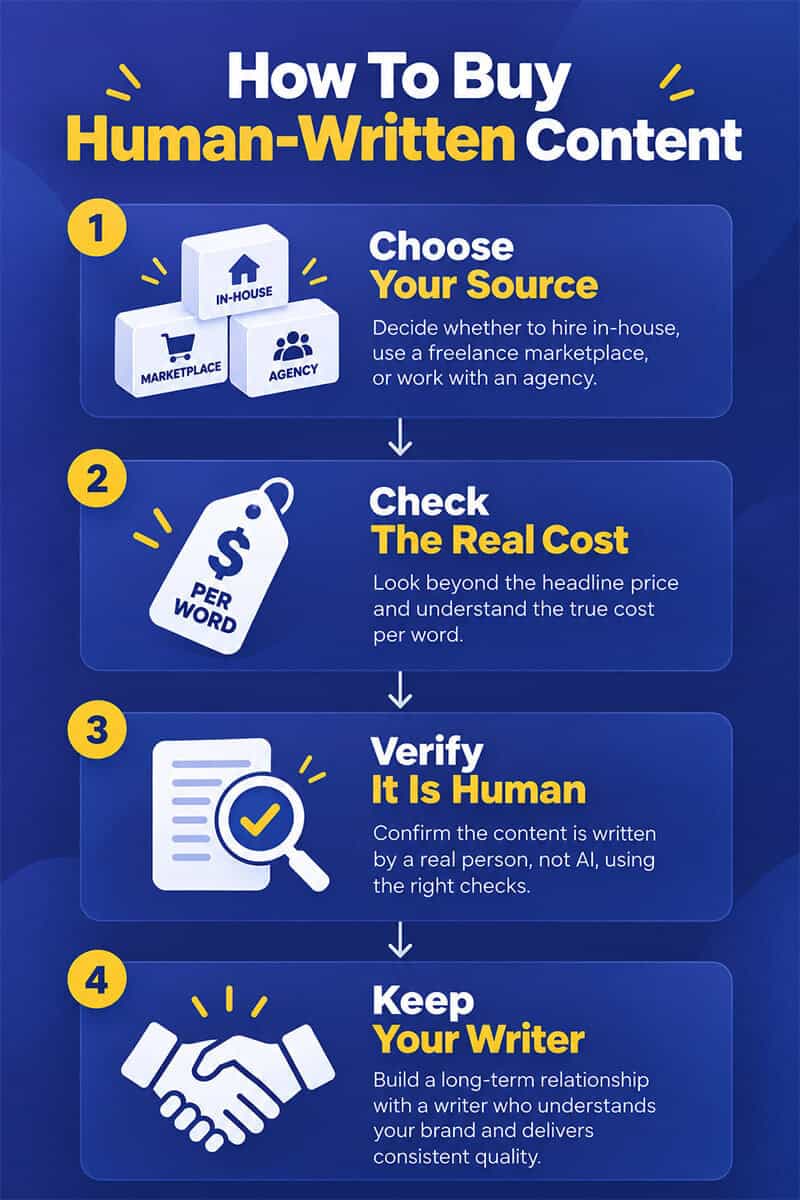
To buy human-written content, you need to hire a trusted content writing service or freelancers who write their own content.
But you also need to have verification safeguards in place that allow you to protect yourself and your business.
Here’s the problem:
Most writers you see advertising content writing services on platforms like Fiverr and Upwork are using AI.

They use AI to write all the content OR they generate the content, edit it a bit and call it a day.
Either way – they’re still using AI.
Their only goal is to beat AI detectors and pass it off as “human-written” content.
But let’s be clear – these people aren’t writers.
They’re simply prompt jockeys posing as writers. Most of them have very little writing talent at all, so they don’t even know what “good” content looks like.
The issue isn’t necessarily that they’re using AI.
It’s that they are claiming to write the content but are really using AI to generate it.
And now more than ever, that AI-generated content is easy to detect. Anthropic already embeds an invisible watermark in the text Claude produces, and OpenAI, Google, Meta, Microsoft and Mistral have all signed the EU code that commits them to the same thing.
So in this guide, I want to show you the exact process to use when hiring real human writers.
And how we make sure every piece created by our content writing services is human verified.
(You can run these checks on your own content too.)
Let’s jump in!

Does Google Penalise AI-Generated Content?
No, Google does not penalise content just because it’s AI-generated.
Google’s AI content search guidelines clearly state they:
“Reward high-quality content, however it is produced”
At least for now…
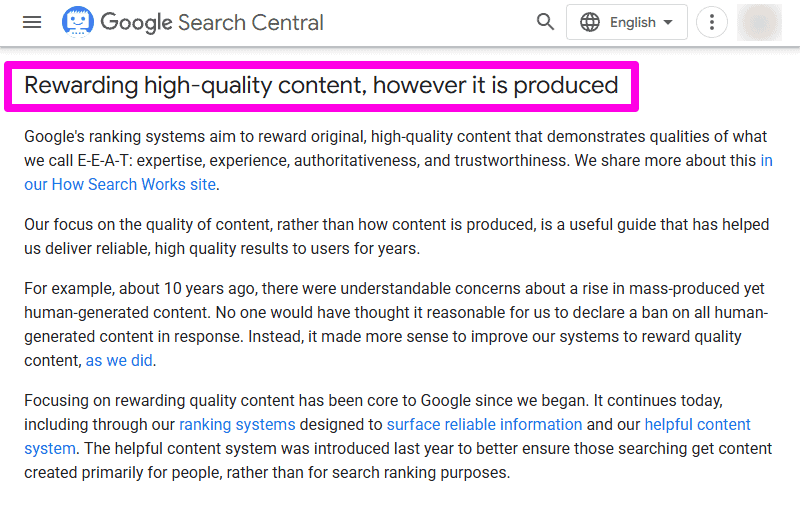
But Google’s current stance is that they are focused on content quality. Not how it is created.
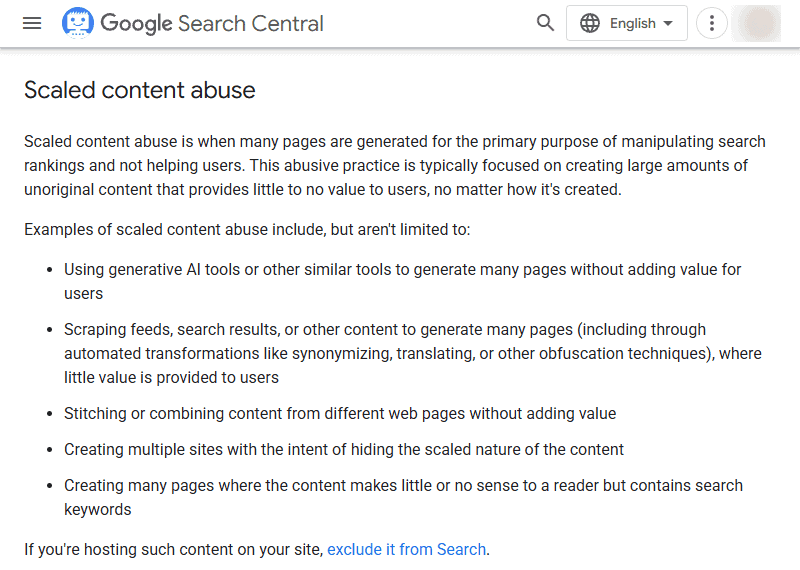
They do have spam policies about scaled content abuse. But that policy is for people pumping out huge amounts of content at scale regardless of quality.
So does that mean you can use AI to write your content?
My stance: No.
The truth is that Google has never been able to reliably identify AI-generated content at scale. That was until now.
Anthropic has started watermarking the text Claude produces, and OpenAI, Google, Meta, Microsoft and Mistral have all signed the EU transparency code that commits them to doing the same.
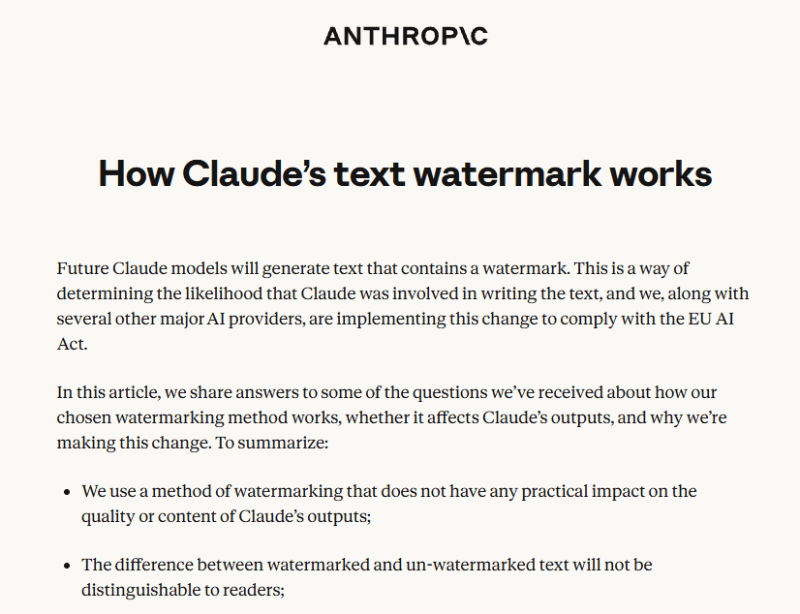
The reality is that I’ve been in SEO long enough to know that Google can flip-flop on a policy they’ve had for years at any moment. And now AI content is getting easier to detect at scale.
Using AI-generated content puts your business at risk.
But the question you need to answer…
Is risking your website reputation worth it?
And that’s why so many businesses and even agencies are switching to human writers they can trust.

Why Should You Only Use Human-Written Content?
Human-written content is worth it so that you don’t risk your website reputation with Google.
It also means your human writers can provide real-world experience and knowledge gain in each piece of content.
Both are essential for being cited by AI search tools like ChatGPT, Perplexity, and Google AI Overviews.
Here’s why you should use human-written content.
Google Could Change Their Minds At Any Time
The big AI detection roadblock is coming down, one model at a time.
Our own detection testing shows how reliably the better tools now flag AI-written articles.

Google could change their minds on AI-generated content at any moment (and they have in the past).
Or at the very least, start adding stricter boundaries to it.
But for me it’s about limiting risk to one of your greatest business assets – your website.
If Google doesn’t ever change its policy on AI-generated content, your human-written content loses nothing. But if Google does decide to demote or penalise your AI content, it’s extremely hard to undo an AI-heavy site with hundreds of pages.
Human-written content mitigates that risk.
Plus, your human writer is adding all the experience and unique information the AI models want to see.
Most people think that content is still about volume.
But with more and more people using AI to generate content at scale, the pros are doubling down on depth.
Depth in topics and in individual pieces.
This type of content is always going to perform well regardless of Google’s policy on AI-generated content.
You have to ask yourself:
Is stuffing your site with AI-generated articles really worth the risk?
Human-Written Content Can Rank Better Than AI Content
Human-written content doesn’t automatically outrank AI-generated content just because a human typed the words.
But the top ranking positions on Google and the most cited articles in AI skew heavily towards human-written pages.
Look at these three independent studies on human-written vs. AI-generated content:
| Study | Data | Results |
|---|---|---|
| Semrush | 42,000 blog pages across 20,000 keywords | Human-written content ranked in position #1 for 80% of keywords. AI-generated content only held position #1 for 9% of keywords. That’s almost a 9x difference. |
| Ahrefs | 1,000,000 pages analysed from 100,000 SERPs | 54.7% of the top 3 ranking pages on Google had low to zero AI content, and 82.2% were under 50% AI content. Only 5.3% of the top ranking pages were pure AI content. |
| Rankability | 487 search results for competitive commercial keywords | 83% of the top-ranking pages in the Google SERPs were not using AI-generated content. |
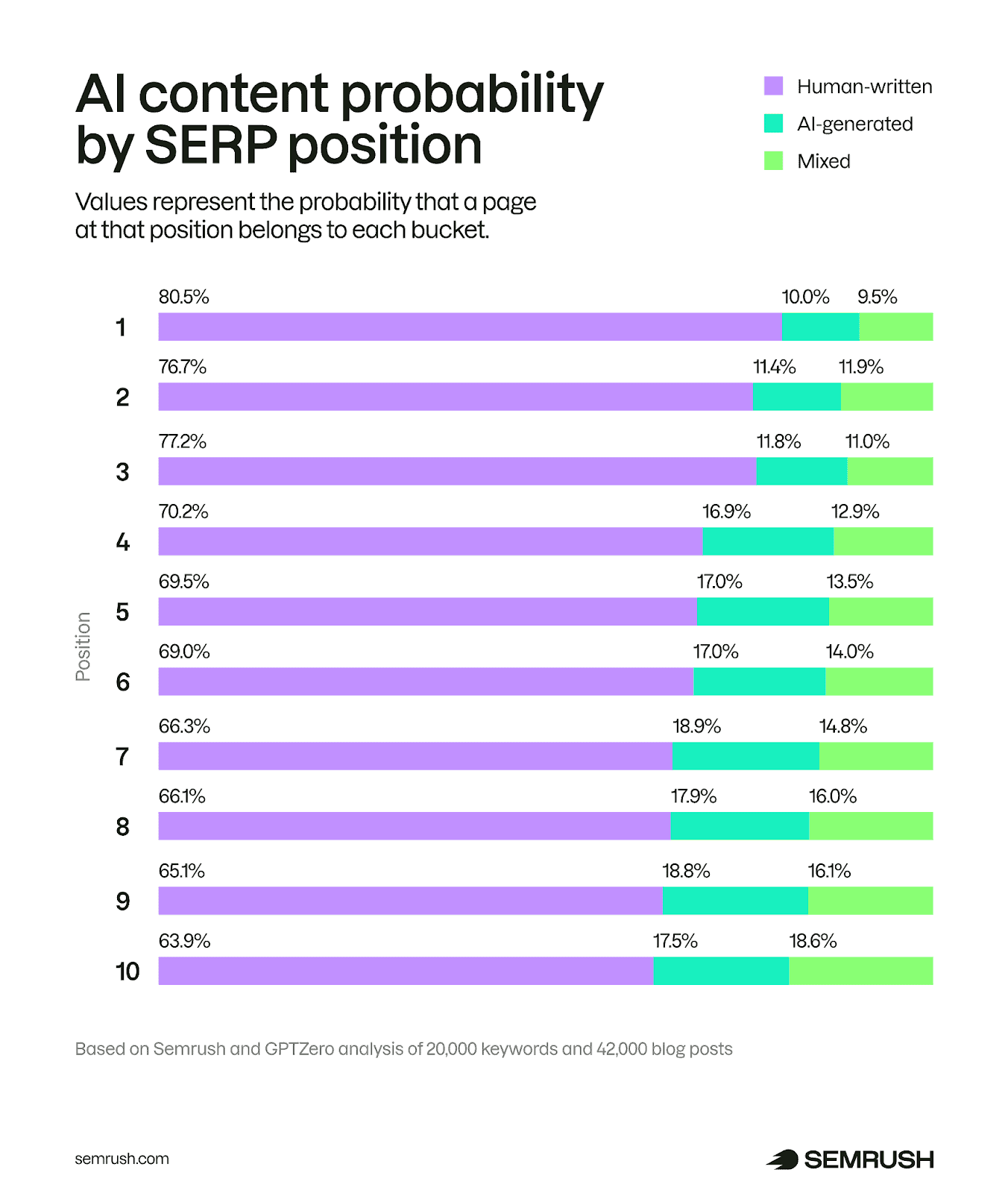
It’s also clear that when you read these studies, AI-generated content can and does rank on Google. It also gets cited by AI search tools.
But there is one huge takeaway that our LinksThatRank content team found when analysing the results of all three studies…
Across all three studies, around 80% of top 3 ranking pages are predominantly human-written.
Here’s the thing:
Do you produce content to rank in position #9?
Of course not.
Every time you write a piece of content, your goal is to rank as high as possible and be cited as many times by AI search tools as possible.
And the evidence overwhelmingly points to the fact that human-written content is more likely to deliver better results.
That’s why so many businesses have turned to human-verified content services.
AI Search Tools Look For “Information Gain”
AI can only rewrite what it already knows.
That means when you generate a piece of content with AI, you’re only publishing what’s already been published.
It might be structured nicely and read well, but it’s still just regurgitating what’s already out there.
That’s why AI search platforms like ChatGPT, Perplexity, and Google are focusing on information gain.
What is information gain?
Information gain is the measure of new information a page adds that is beyond what already exists online for that topic.
Think of it like the gap between what AI has read before and what it’s reading on your page.
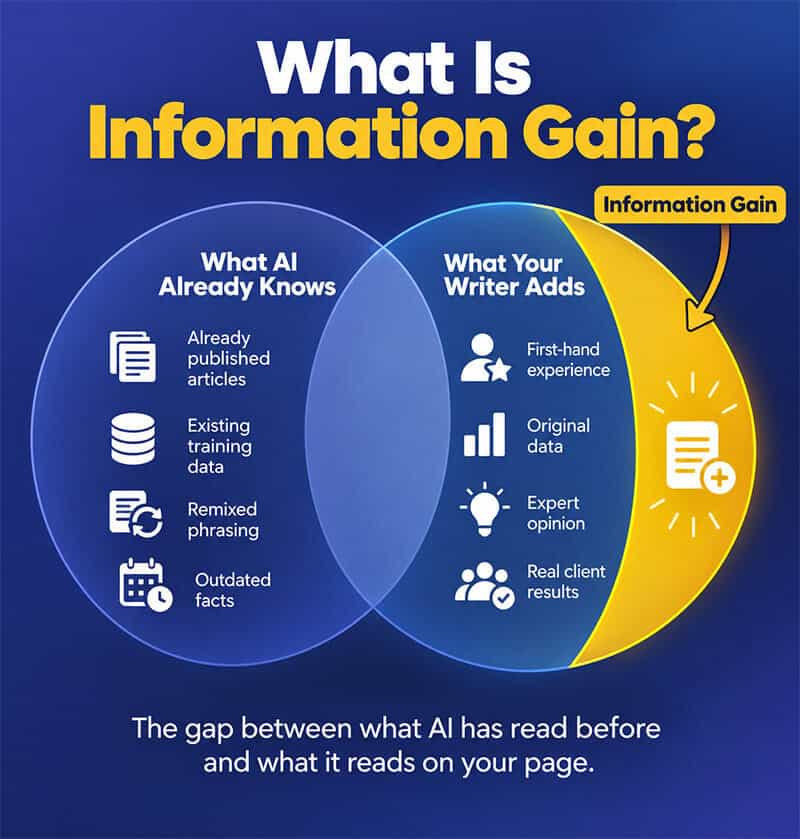
And that’s a big problem for AI-generated content.
AI can only rewrite what it knows.
Most Large Language Models (LLMs) like Claude, Gemini, and ChatGPT are trained on existing web information.
So they simply remix what they know and publish it using different words.
And sometimes the content they produce is outdated because the models pull from outdated training data.
That’s why you see a lot of mistakes with AI content.
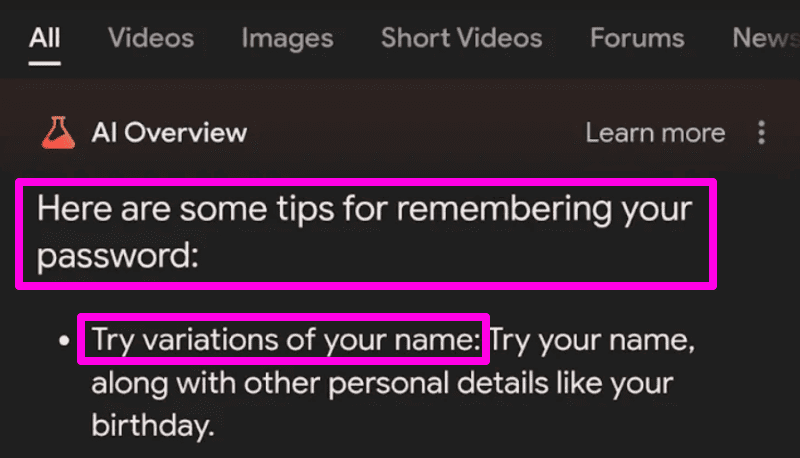
Like the query ‘how to remember your password’ here got quite the wrong training!
Only human writers can publish:
- First-hand human experience
- Original data
- Expertise-driven content
And that’s the difference.
If you’re serious about getting cited by AI search tools, you need original content that adds new information online about the topic.
Where Can You Order Human-Written Content?
You can order human-written content from five places:
- Hire in-house writers
- Freelance marketplaces like Fiverr and Upwork
- Pre-written articles from content houses
- Professional SEO content writing services
- Referrals from niche writing communities
No option is necessarily better than the others. It depends on your business and goals.
But there is a significant difference in quality and risk of AI use.
Here’s a breakdown so you can see the differences:
| Source | Best For | Typical Cost | AI Use Risk |
|---|---|---|---|
| In-House Writer | Expert YMYL content that requires E-E-A-T | $0.30 to $1.00 per word | Low |
| Freelance Marketplace | Flexible orders with customised briefs | $0.05 to $0.50 per word | High |
| Content Writing Service | Ongoing quality SEO content at scale | $0.08 to $0.30 per word | Low to Medium |
| Pre-written Catalogues | Instant delivery to fill one-off content gaps | $30 to $200 per article | High |
| Referrals from Niche Writing Communities | Finding proven writers quickly | $0.10 to $0.50 per word | Low to Medium |
Hiring an in-house writer gives you more control and the lowest risk of them using AI to generate the content.
The downside is that you need steady volume so the writer sticks around.
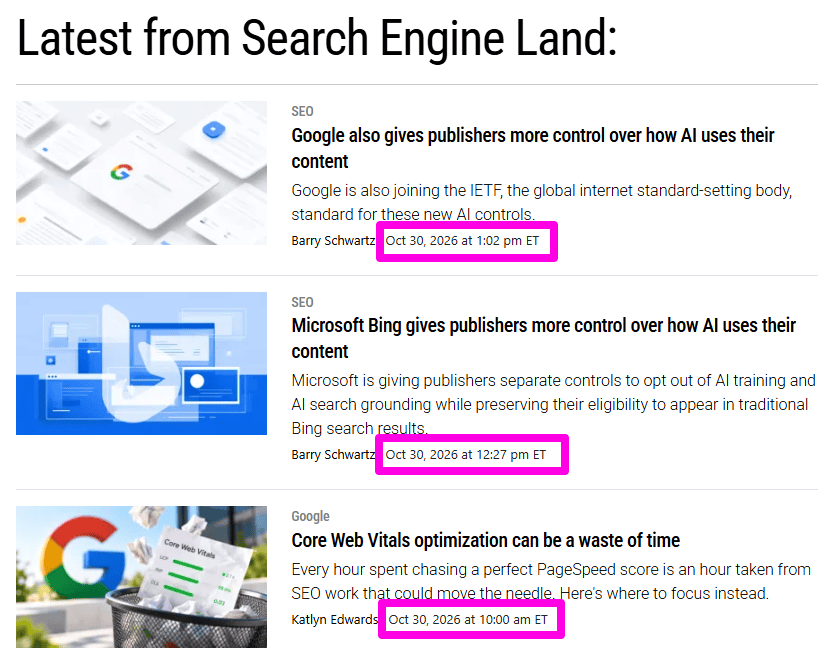
If you do go that route, referrals are the best way to find them.
But always do a paid test before you hire long-term.
The worst places to order human-written content are freelance marketplaces and pre-written articles from catalogues.
With freelancers, you have very little control over quality.
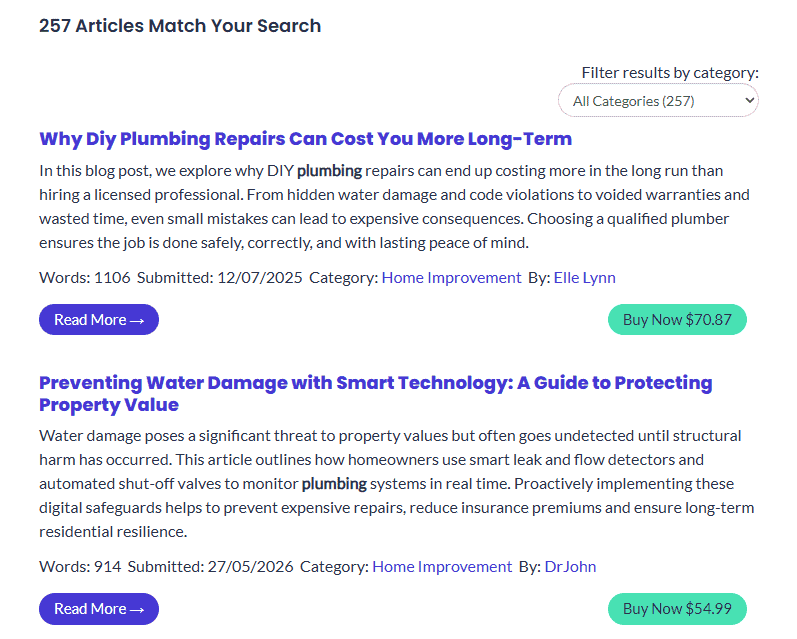
And when you buy pre-written articles from places like Constant Content, you need to be very confident in the content they’re producing.
The last thing you want is to order a piece of pre-written content that has been sold and published multiple times.
What about professional content writing services?
Good services are typically low risk as long as they guarantee human verification.
The benefit is that you can order content on demand and scale up or down as needed.
You also get the benefit of a team of quality writers who know how to write quality SEO content.
Want quality content that is guaranteed human verified?
LinksThatRank content writing services are produced in-house and screened by two independent AI detectors, Pangram and GPTZero.
We only deliver an article once both detectors pass it.
Here’s what comes with every article:
• Human verified by Pangram and GPTZero
• 2 custom images, free of AI watermarks
• Entity-focused keyword optimisation
• Professional proofreading and editorial review
• Delivered as a Google Doc you own outright
• 21-day standard delivery, or 2-day express as a paid upgrade
Every article is professionally written for Google and built for AI search.
Place a test order now and see the difference for yourself.

How Much Does Human-Written Content Cost?
Human-written content typically costs between $0.08 and $0.30 per word.
The amount you pay depends on the topic and writer quality. The better the content, the more you pay.
For specialist writers creating content on YMYL topics with real E-E-A-T signals, prices can even be as high as $0.50 to $1.00 per word.
Here’s a breakdown of typical human-written content costs based on writer quality:
| Tier | Per Word Cost | What You Get |
|---|---|---|
| Entry Level Writers | $0.03 to $0.07 | Focus on volume with minimal research and higher AI usage risk |
| Experienced Writers | $0.08 to $0.20 | Well-researched SEO content, unique information, and good quality content |
| Industry Specialists | $0.30 to $1+ | First-hand experience with the topic written by a real specialist writer |
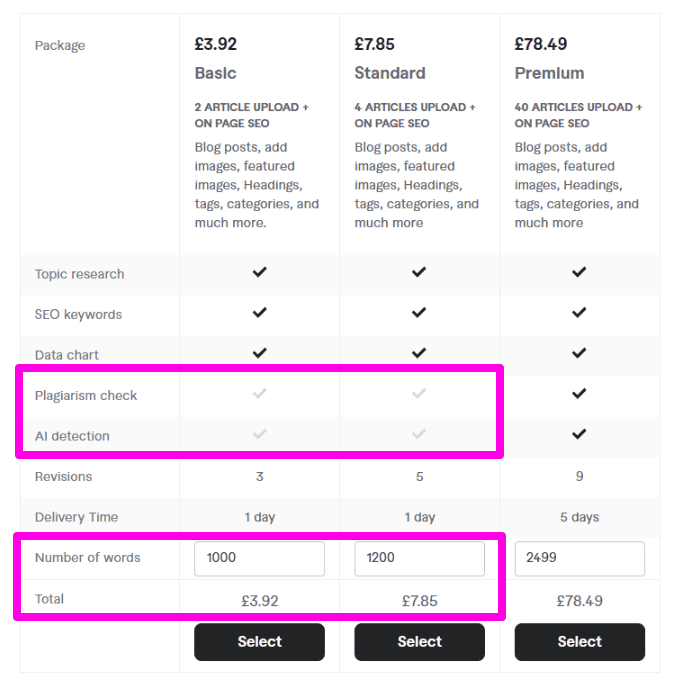
It no longer makes sense to hire entry-level writers.
The reality is that anyone charging less than $0.07 per word is likely using AI in at least some part of the article. You’re simply not paying enough for a genuine human writer to spend time on it.
That’s why we highly recommend hiring industry specialist writers in-house that you can train or using a professional human-verified service like LinksThatRank.
How much do LinksThatRank’s human-verified writing services cost?
Our prices are:
- 1,000 words for $97: perfect for shorter blog posts
- 2,000 words for $177: ideal for competitive topics
- 3,000 words for $227: comprehensive pillar content
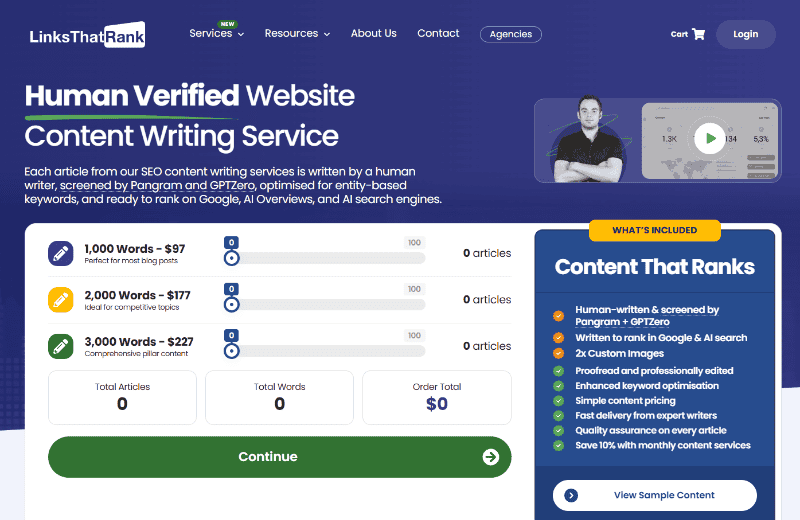
Plus, we also offer a 10% discount for monthly subscriptions.
That works out at $87, $159 and $204 a month for the three word counts.
You can change, upgrade, or cancel your monthly subscription anytime.
There are no lock-in contracts or long-term commitments required to get the discount.
Place an order now and let our specialist team take care of your SEO content needs.

How To Verify That Content Is Actually Human-Written
To verify that content is human-written you need a process with multiple levels of verification.
Using AI content detectors like GPTZero and Pangram is a good step. But AI detectors are just part of the process, not the whole thing.
Use the steps below to verify that each piece of content is actually human-written.
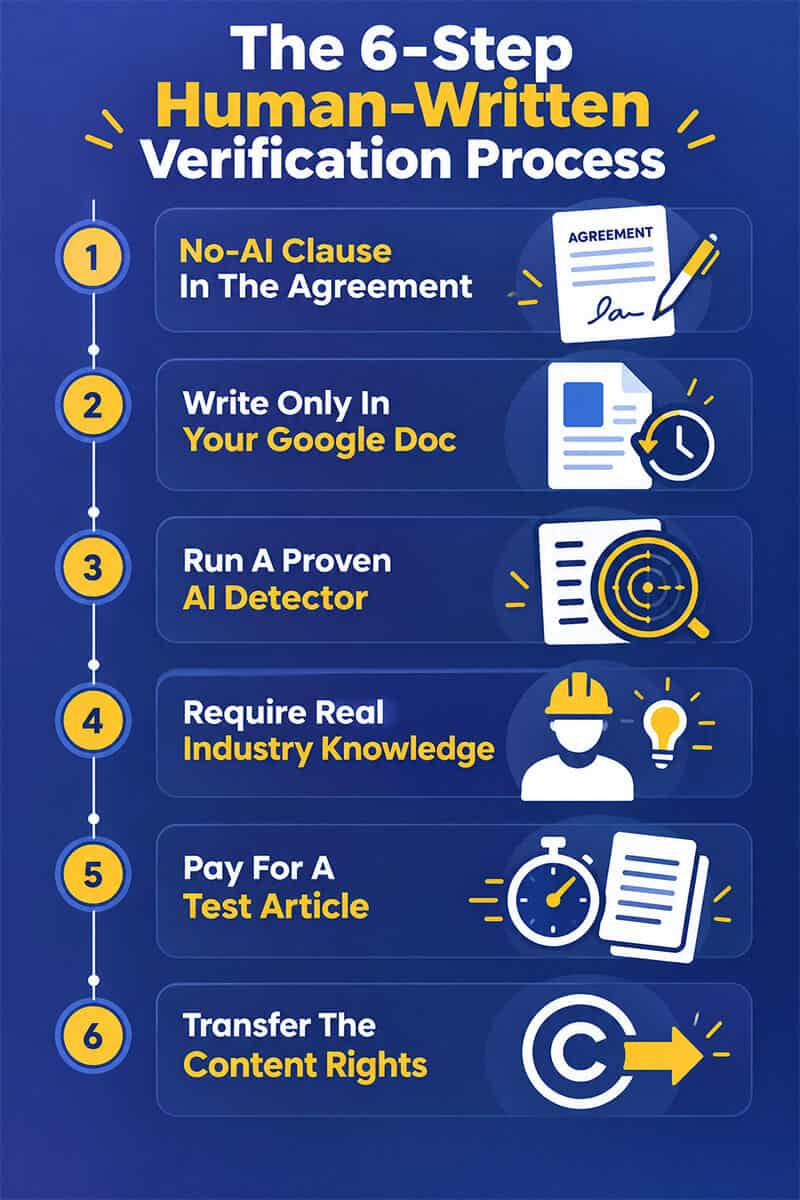
Step 1: Write A No-AI Clause In Your Hiring Agreement
The first step in preventing AI content is adding a no-AI clause to your hiring agreement.
You’re essentially getting the writer to agree not to use AI content.
This has to be in writing, and it’s something that you want to point out directly to the writer.
Be upfront about your policy.
A good AI clause does three things:
• Explains that AI content is banned
• Defines how your business checks for AI content
• States the consequences if AI content is found
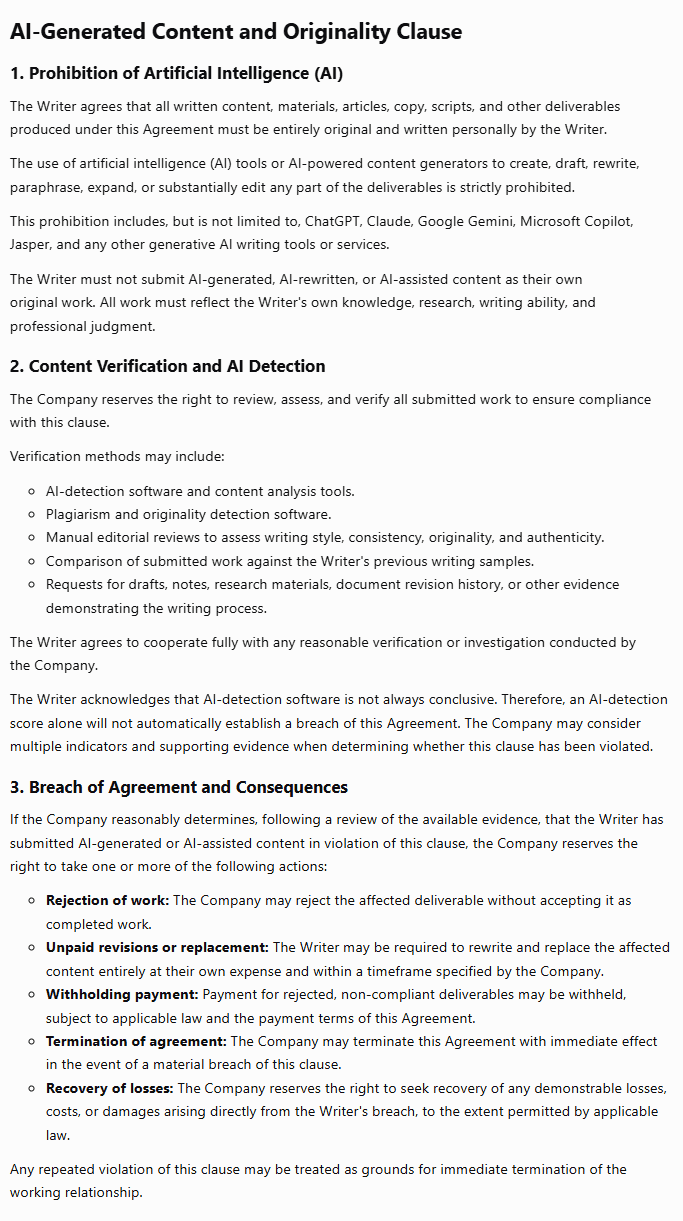
This ensures that writers understand what’s expected from them and the boundaries of using AI.
But you also need to explain when it’s okay to use AI for part of the writing process.
For example, AI is great for research, drafting outlines, and putting together content briefs.
You need to decide what AI is going to be used for.
My recommendation is that you do the research and blog outline. Then hand the writer a comprehensive brief they can use to write the content.
That way you’re still using AI to improve the content production process while ensuring your writer produces quality human-written content.
Write your No-AI clause first.
Then document your entire content production process and where you’ll use AI.
You need to have this in place before moving on.
Step 2: Only Use Google Docs For Content Writing
Google Docs version history is the single best tool for verifying human writing.
Let me explain how it works:
Create the Google Doc yourself for each new blog post you’re giving to your writer. Then share the Doc with edit access.
This is where they will do the writing.
Give them the article brief with view-only access on a separate Doc.
The writer should only write on the first document you give them. No duplicating the Doc or writing in a different place, then copying it over to the Doc.
This is important.
Why?
Because you can see all of the edits and changes the writer makes on the Google Doc. That means it’s easy to see if they’re copying and pasting large chunks of text over.
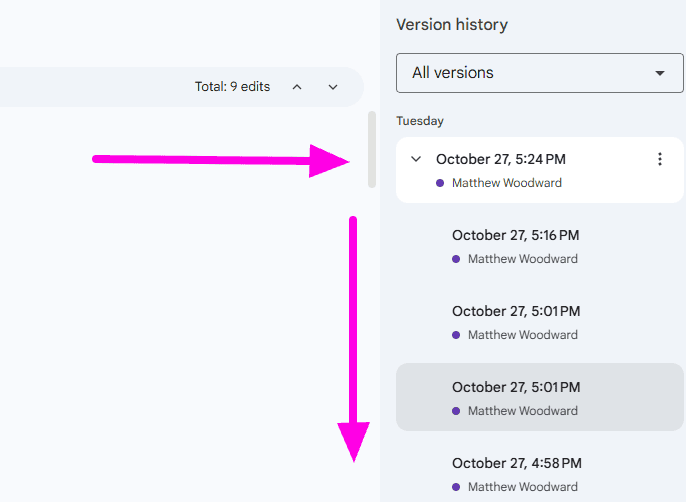
All you need is a tool that replays the Doc’s changes word by word.
For that, we recommend the GPTZero Chrome extension.
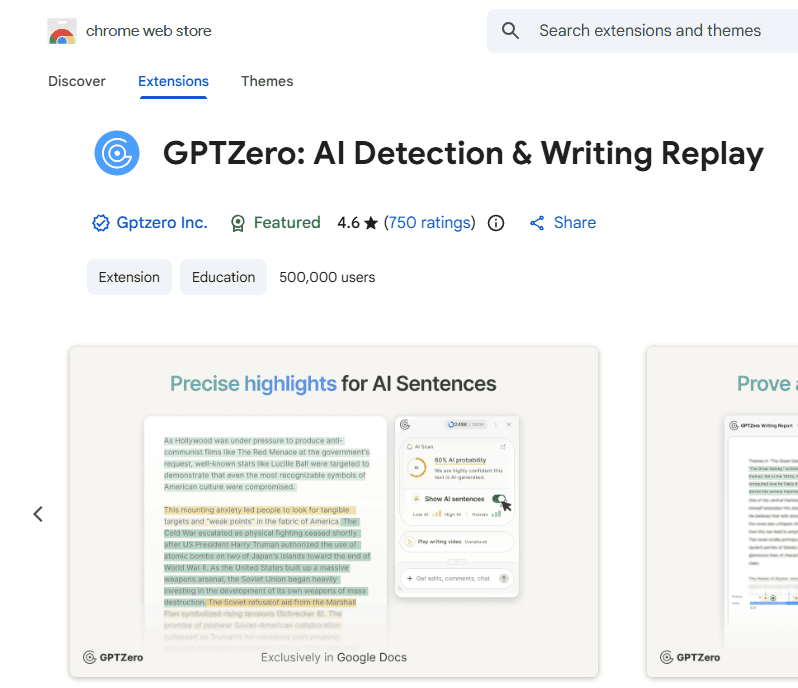
Its Writing Report includes a feature called Writing Replay.
It’s essentially a video replay of the writer writing in real time.
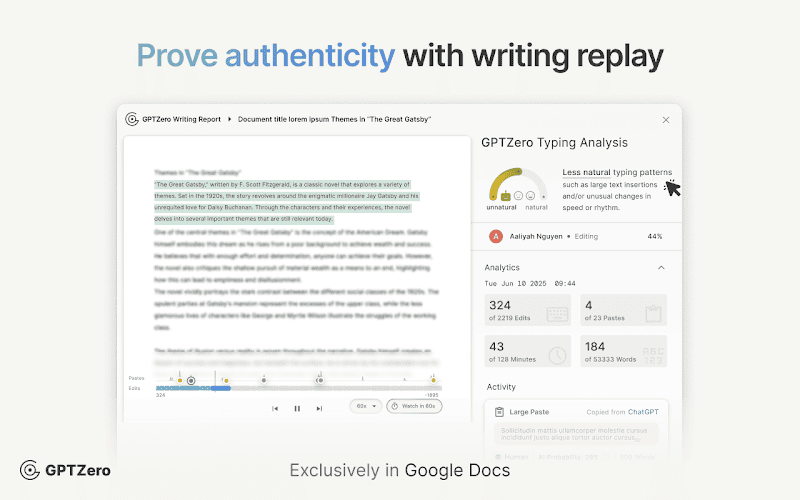
You can see each character and word being typed out.
The extension even points out times when large chunks of text were copied and pasted into the Doc.
If the AI detector flags content as AI-written, you can go back to the replay and verify it for yourself.
Simple, right?
This lets you overrule false positives and also protects your writers’ reputation. That’s a win-win for both you and the writer.
This step is a must to prove original human-written content.
Step 3: Use A Proven AI Content Detector Tool
There are tons of AI detectors out there on the market.
Very few of them are reliable.
Most AI detectors provide coin-flip results that you can’t really depend on. The last thing you want to do is falsely accuse a writer of using AI.
On the other hand, you don’t want AI content to slip through your fingers.
Does that mean all AI detectors aren’t reliable?
Short answer: No.
But the most reliable detector can change from one update to the next.
I ran a test using 11 of the top AI detectors to see if they could reliably detect AI content written by 14 popular AI writing tools.
I also gave them my own human-written content to see if there was a difference.
You can read the whole AI detection case study on SearchLogistics.
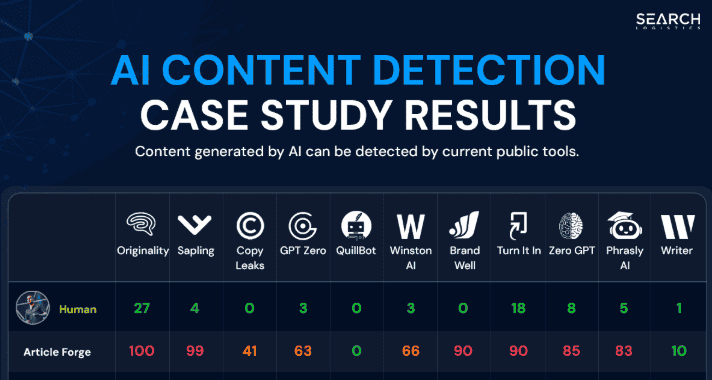
The winner at the time?
Originality.ai. It was the most reliable by a long way, so we used it for years.
That all changed in October 2026.
When the latest version, Originality 5.0, was released, it started flagging content our writers had created.
At first, we panicked that everyone was using AI.
But then I tested my own articles. Articles I wrote before AI was even released to the public.
They also got flagged as AI, even though that’s impossible.
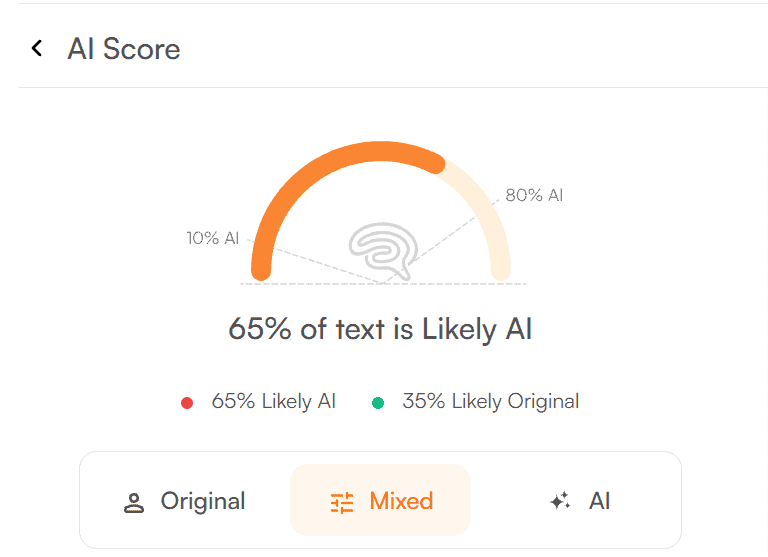
Moral of the story:
A single AI detector update can start failing your real human-written content.
PRO TIP: We also now keep a Google Drive folder of 100% real human content for sanity testing, in case a detector update suddenly starts failing our writers.
The Google Sheet that tracks it is simple:
• Writer name (Matt Woodward)
• Google Drive URL to the article for fast retesting
• Detector name (Pangram, GPTZero)
• Detector version (1.5, 2.3)
• Detector result (99% Human, 51% AI)

The outcome:
We retired Originality and moved to two independent detectors:
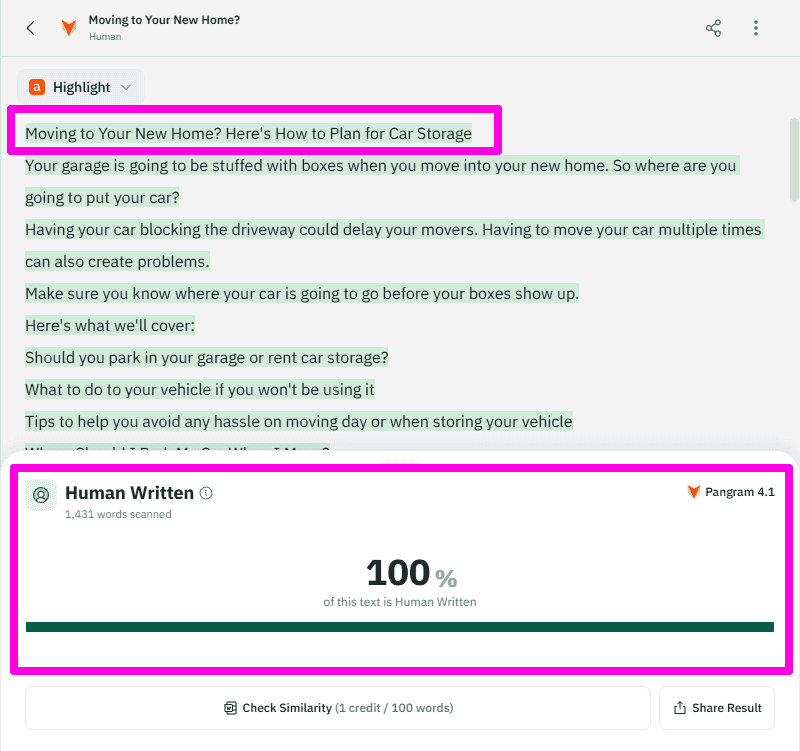
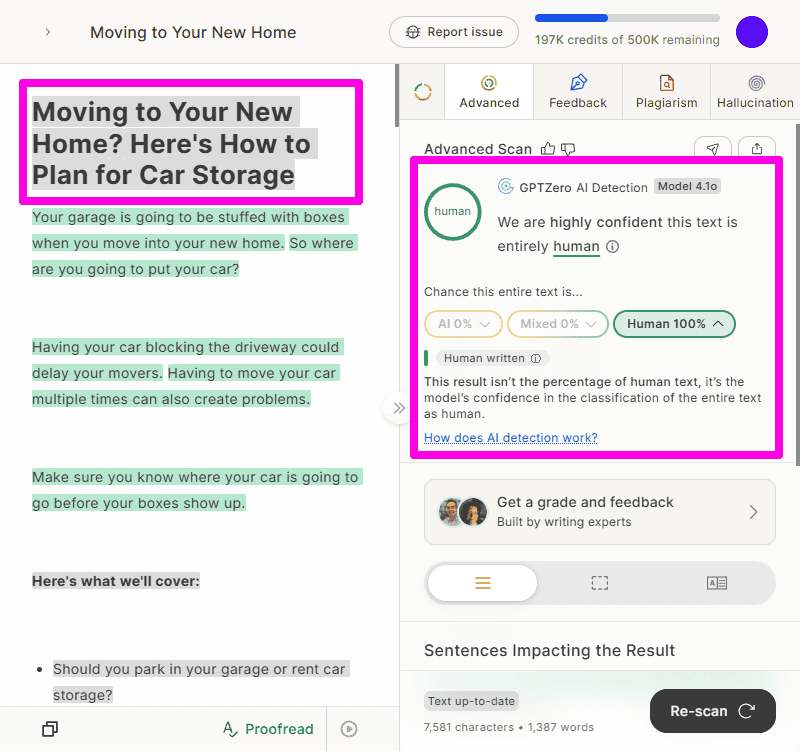
Pangram came out on top as the most reliable detector in a University of Chicago Booth study. It had almost no false positives.
Pangram was also the only one of four detectors to show good results in a peer-reviewed 2026 study, detecting 97.5% of papers that were 100% AI-generated.
GPTZero is very popular as well. Like Pangram, it had zero false positives across 495 human-written passages in Epoch AI’s July 2026 test.
Why Use Two Detectors?
They’re built and trained in different ways, by different companies. So one tool’s blind spot is much less likely to slip past both.
Now you can run each article through both, and only accept it if both classify the content as human.
That’s exactly how our own human-verified content service works.
Every article is screened with Pangram and GPTZero, and we only deliver it once both detectors pass it. Simple as that.
But, of course, every tool can throw up false positives from time to time.
No tool is perfect.
That’s why AI detectors are part of the process and not the whole process itself.
Step 4: Require Writers With Real Industry Knowledge
Writers with real industry knowledge are almost a prerequisite for information gain.
A writer who has actually worked in the industry can add experience and authority that AI models can’t replicate.
But knowledge doesn’t automatically mean information gain.
The reality is that the writer still needs to understand the industry.
This includes things like:
- Knowing the correct terminology
- Understanding important concepts
- Having real-world experience
But information gain can actually come from you personally. This is where you can help.
Think of it like ghostwriting…
The writer’s brief should contain all of the information the writer has to cover when creating a piece of content. You can add points from your own personal experience that are unique.
That’s the information gain part.
Here’s what you can add to a brief:
• A mistake you made and what it taught you
• Real numbers or results from your own business
• A process or tool you actually use
• An opinion that goes against the usual advice
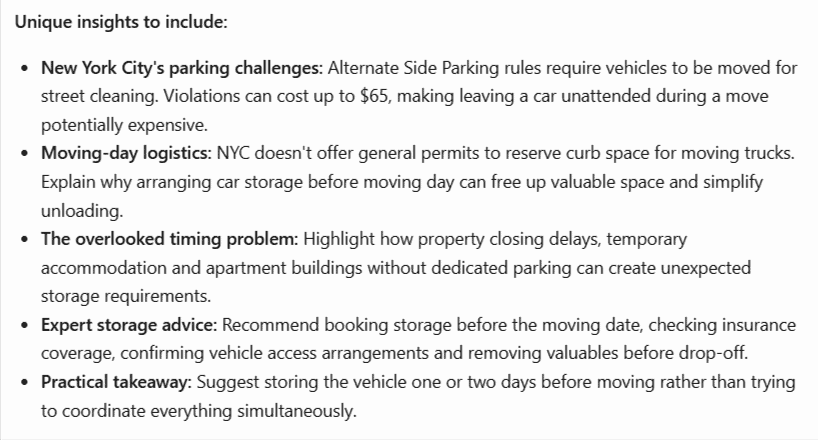
Then the writer simply writes the content based on your own unique experiences.
We’ve built this into the LinksThatRank human-verified content service. When you place an order, there is an option to add content guidelines in the form.
Our writing team will ensure that’s part of the content.
That way, every article is completely unique and has information gain. That’s exactly what AI search is looking for.
Step 5: Run A Paid Test Article Before Working With A Writer Full-Time
A paid test is a shorter writing assignment where you pay 2-3 writers before deciding who to move forward with.
This is a must for content quality and ensuring that the writer will comply with your AI guidelines.
The most important thing is that it’s a paid test.
You want each writer you’re testing to put the time and effort into the work. You also want to assess the quality of their work.
That’s how I’ve hired every writer for the past 15+ years.
We get a few candidates that look good and give them a paid test for real topics.
It’s the only way to properly ensure the writer delivers the standard of content you need.
Here’s how to run one:
• Shortlist 2-3 writers
• Pay each one for a real article
• Check the Doc replay and run both detectors
• Hire the writer who delivers the best work
It’s the same for writing services.
Place a test order of 2-3 pieces first. Then you can evaluate the output and see if it meets the quality standards you have for your business.
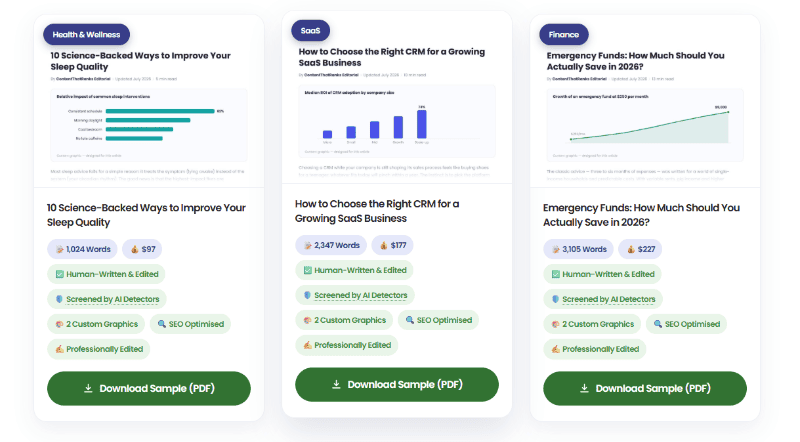
You can also download three full sample articles before you spend anything, one at each word count, with the custom images included.
LinksThatRank allows you to order content on demand.
That way you can see the quality of content that our writing team produces before moving to a discounted subscription.
Step 6: Make Sure That You Own The Content Rights
Your agreement should clearly state that you own the rights to the content after it’s produced.
That means the copyright for the content transfers to you at delivery or payment.
This protects you from the writer:
- Reselling the same content later
- Using it in another project
- Claiming it as their own
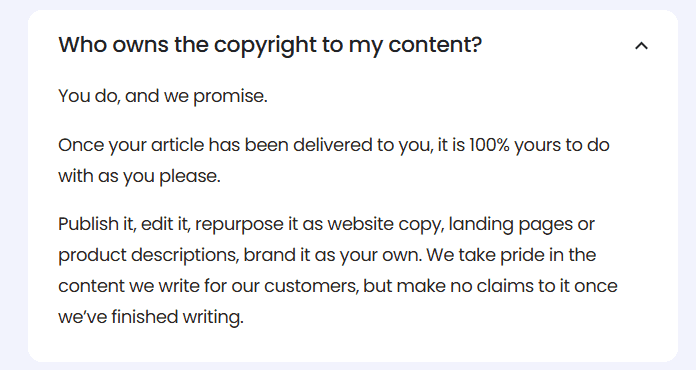
It’s important to know that this is pretty standard in the content writing industry. I’ve never had a problem with writers I’ve hired on this issue.
But it should be part of your agreement either way.
That way you and your writers understand the copyright terms.
Our content rights are simple at LinksThatRank.
We produce the content for you, and it’s yours on delivery. The moment we receive payment and deliver the piece of content, it’s yours to use as you want.

How Do You Keep A Good Human Writer?
What good writers want most is a steady flow of work and reliable on-time payments.
Good writers leave clients that are chaotic or overly controlling.
Remember that you’re hiring someone creative.
You want them to use their creative talents to produce the highest-quality content for your business.
That means giving them the space to use their creativity and trusting their own process.
Does that mean you can’t have guidelines?
Of course not. Good writers want to know your guidelines and expectations. But then give them the space to do their thing.
Simple as that.
Here’s how I see it…
Keeping a good writer comes down to three things:
- Providing consistent work
- Paying on time
- Having clear, simple processes
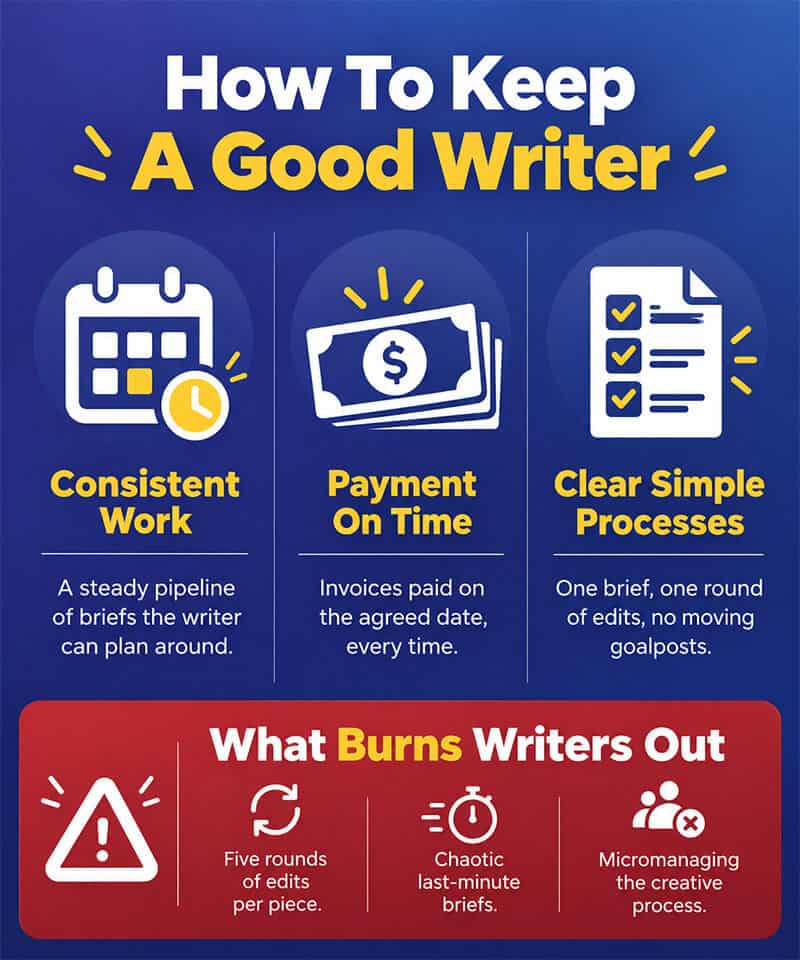
The biggest mistake that I see in the writing industry is brands being too heavy-handed. Nothing burns a writer out faster than 5 rounds of edits for each piece.
Trust the creative process and boundaries that your best writers set.
That’s how you hold onto them and ensure they produce the best work for your business.
That’s the goal at the end of the day, right?
When Is AI Fine To Use For Content Production?
AI is fine when it assists human workflows rather than replacing human writers and human thought.
Ahrefs found that 86.5% of top-ranking content used at least some AI assistance to produce the content.
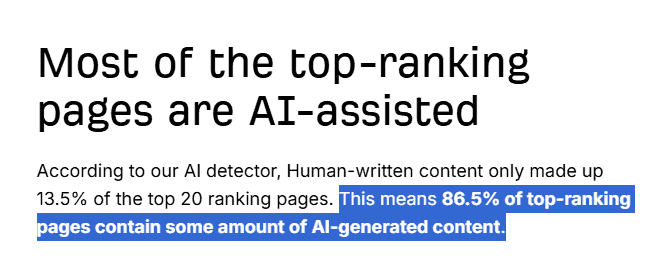
Using AI as part of the process is normal. But using it to completely replace human writers and original human ideas is the fastest way to put your business at risk.
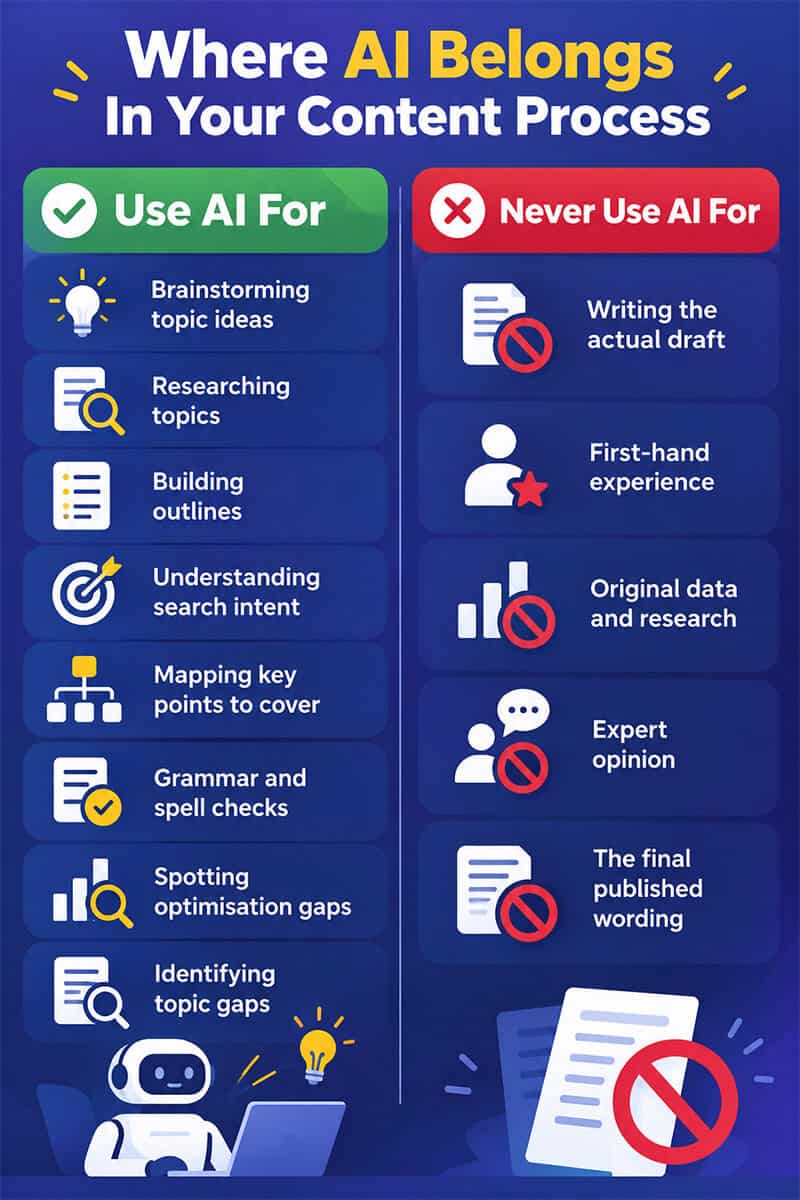
Here’s where AI should be used in the content writing process:
- Brainstorming new topic ideas
- Researching topics thoroughly
- Helping with creating outlines
- Understanding search intent
- Seeing what key points must be covered
- Running essential grammar and spell checks
- Pointing out areas for optimisation
- Identifying topic gaps
That’s a lot, right?
That frees up your human team to focus on original perspectives and thought leadership.
That’s the kind of thing that Google and AI search models want to see.
But keep AI out of:
• Writing the article itself
• Adding first-hand experience or opinions
• Making up examples or data
Wrapping It Up
Publishing AI content can put your website at risk.
No one can predict what Google or AI search platforms will do in the future. Between AI detector tools and AI platforms watermarking content, detecting AI content is only getting easier.
But the good news is that you can buy human-verified content easily.
The two best options are:
- Hire an in-house writer
- Order from a trusted human-verified writing service
If you choose to hire writers yourself, make sure that you have a verification process in place.
Start by adding an AI-content clause to your agreement and only hiring writers who are happy to sign it.
Then create a process that allows you to check writing thoroughly using Google Docs and AI detector tools.
Here’s the full verification checklist:
1. Add a no-AI clause to your agreement
2. Make writers work in a Google Doc you own
3. Run every piece through two independent AI detectors
4. Hire writers with real industry knowledge
5. Pay for a test article before you commit
6. Make sure you own the content rights
This will protect your website and your writers’ reputation.
Want quality written content without all the hassle?
LinksThatRank human-verified writing services make it easy to order content whenever you need.
Our services allow you to customise your order and add unique insights so you’re only getting quality content that offers real information gain.
Each article we produce is optimised to rank in Google and built for AI search platforms like ChatGPT, Perplexity, Gemini, and Google AI Overviews.
Place a test order now and see the results for yourself.
- Content Writing – Buy human verified by Pangram and GPTZero
- Guest Posts – Ranking target pages in search engines
- Link Inserts – Domain authority without new content
- Authority Asset™ – Digital PR links from journalists & bloggers
- Listicles – Buyer-intent visibility + AI citations
- Reviews – Brand trust + AI answers
- Discounted Packages – Up to 17% off monthly links
- Agency Account – 15% off our products for client campaigns
Frequently Asked Questions
Is human-written content better for SEO?
Human-written content has been shown to rank higher in Google’s search results, especially for more competitive terms. But being human-written doesn’t automatically mean that it will perform better for SEO. Semrush analysed 42,000 blog pages and found that human content held position 1 for 80% of keywords, while AI content held the same position for just 9%. Unique content with real information gain is what matters most.
How much does human-written content cost?
Human-written content costs between $0.08 and $0.30 per word. For specialist writers with their own credentials creating content on competitive YMYL topics, prices can often be as high as $0.50 to $1.00 per word. The amount you pay depends on the topic, industry, and writer quality.
Can AI detectors prove content is human?
No, AI detectors cannot prove that content is human 100% accurately. They work by calculating the statistical probability that a piece of content is AI-generated vs. human-written. But the best detectors like Pangram and GPTZero are very good at detecting AI content vs. human-written content, and running both makes a false result much less likely. That’s why proven AI content detectors should be a part of your AI detection process.
What is the difference between human-written content and humanised AI content?
Human-written content is written by a real person and contains first-hand experience about the topic. Humanised AI content is simply AI-generated content that has been run through a humaniser tool. The humaniser tool is supposed to rewrite the content to mimic real human writing. Humanisers have been proven to be ineffective against good-quality AI detection tools.