
If your firm doesn’t show up in both places, your competitors win even when their legal work is worse than yours.
Fix it by optimising your Google Business Profile, collecting reviews, building quality backlinks, and publishing content that ranks and converts.
SEO for attorneys helps law firms rank higher on Google and get recommended by AI tools like ChatGPT and Perplexity.
The key strategies include optimising your Google Business Profile, building quality backlinks, and creating content that converts visitors into paying clients.

Does your law firm show up when people search?
85% of people who need legal help use Google to research lawyers. Think about that for a second…
Nearly every potential client uses Google to find law firms near them.
Now, combine that with the fact that 38% of people regularly use AI search tools like ChatGPT and Perplexity to search online.
The problem is simple…
If potential clients are not finding your firm when they search, they’re finding your competitors. Even if you offer better legal services, your competitors simply win because they have better SEO.
What’s the good news?
SEO can be fixed. You just need the right SEO strategy for attorneys and approach.
I’m going to show you step by step how to rank higher on Google and get recommended in AI answers.

Why Attorney SEO Is Worth the Investment
Attorney SEO is worth the investment because it drives a consistent stream of high-intent, qualified leads without the ongoing cost of paid ads.
Search is the number one channel for law firms to acquire new clients.
85% of people who need legal help start by searching on Google. And 38% of people are now also using AI tools like ChatGPT, Gemini, or Perplexity for research.
That means your firm needs to show up in both places.
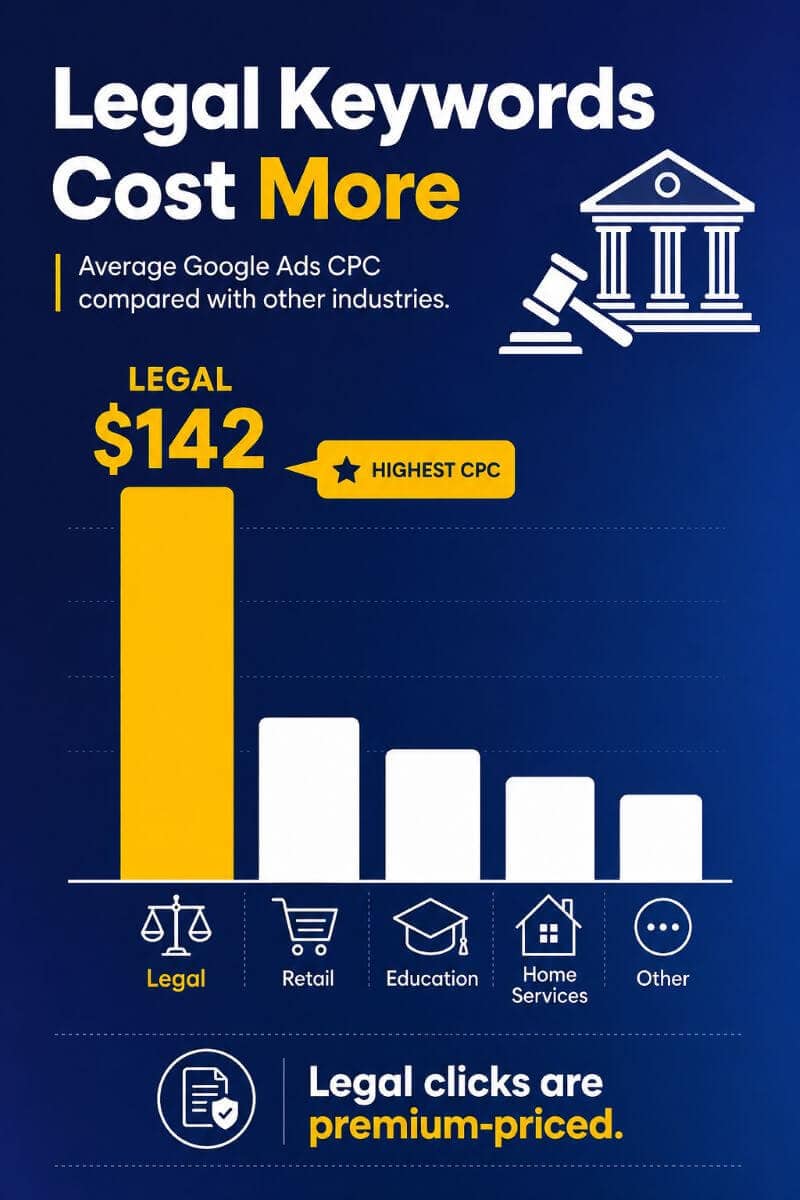
The problem is that Google Ads is expensive.
The average cost-per-click for high-intent legal keywords is $142. You’re essentially paying $142 just for a click, regardless of whether they convert.
SEO changes that equation.
You get the same leads without having to pay for every click. That’s why the average law firm SEO campaign delivers an ROI of 748%.
And here’s what makes that even better…
Clicks from AI search tools convert 4.4x higher than traditional search.
A strong legal SEO strategy helps you rank higher on Google and get recommended in AI search tools at the same time.
There has never been a better time to invest in SEO.

Local SEO Strategies for Attorneys
Local SEO is the foundation of any attorney SEO strategy.
46% of all Google searches have local intent.
That means nearly half of all law firm searches are from people in your area actively looking for legal help right now.
Just by following our local SEO process, you should already start to see results. Here’s exactly what you need to do.
1. Optimise Your Google Business Profile
Your Google Business Profile (GBP) is the single most important asset for local attorney SEO.
Let me explain:
When someone makes a search on Google such as:
- Personal injury lawyer near me
- Family law attorney in [city]
- [city] small business lawyer
Google shows a local map pack of the top three Google Business Profiles like this:
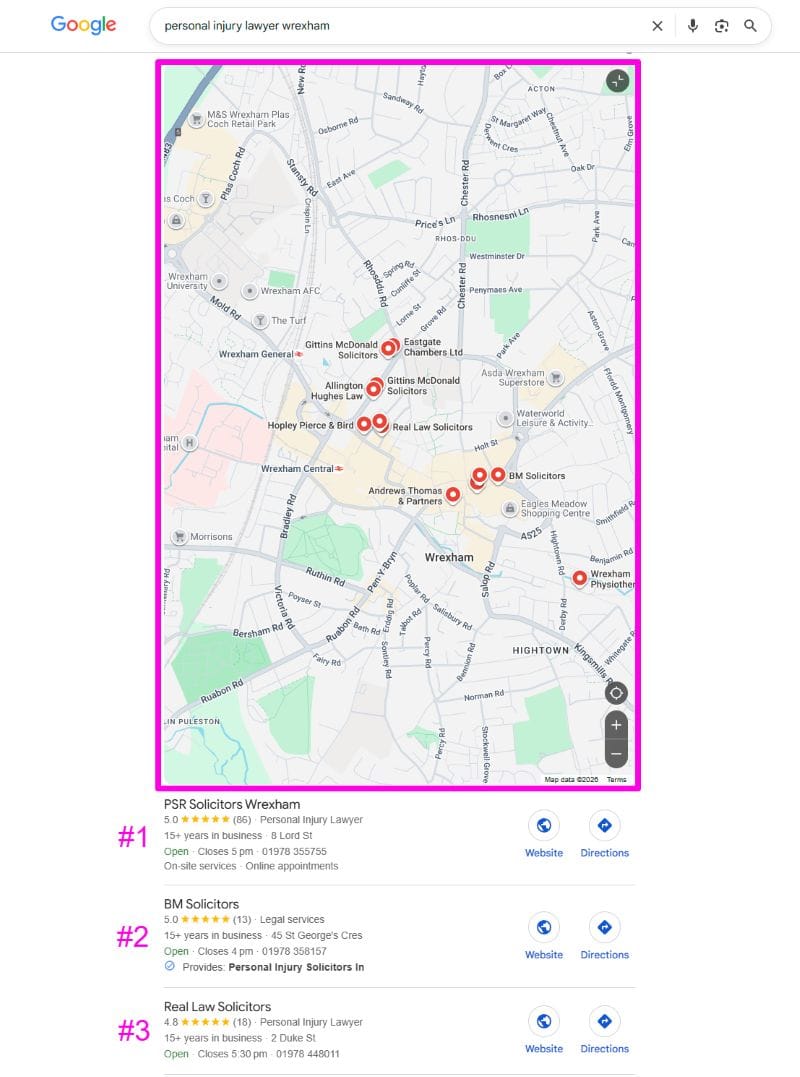
These top three profiles are called the “local map pack”. And ranking in these results consistently is like finding a gold mine.
75% of users only engage with those top three results.
If your firm doesn’t rank there, you are essentially invisible to 3 out of 4 searchers.
Crazy, right?
And it’s the same for AI search tools as well.
Optimising your Google Business Profile and competing for the local map pack should be your first priority.
The good thing is that it takes less than 30 minutes to claim, verify and optimise your profile correctly.
If you haven’t already, search for your firm on Google and click the “Own this business?” link.
Go through the steps to claim and verify your profile.
You can do this by:
- Phone
- Postcard
The whole process should take less than 5 minutes. But it’s essential to do it now before you move on.
The next step is to fill out your Google Business Profile completely.
Think about it like this…
Google trusts law firms that it understands. The more information Google has about your firm, the more confident they are to recommend you to its users.
Simple as that.
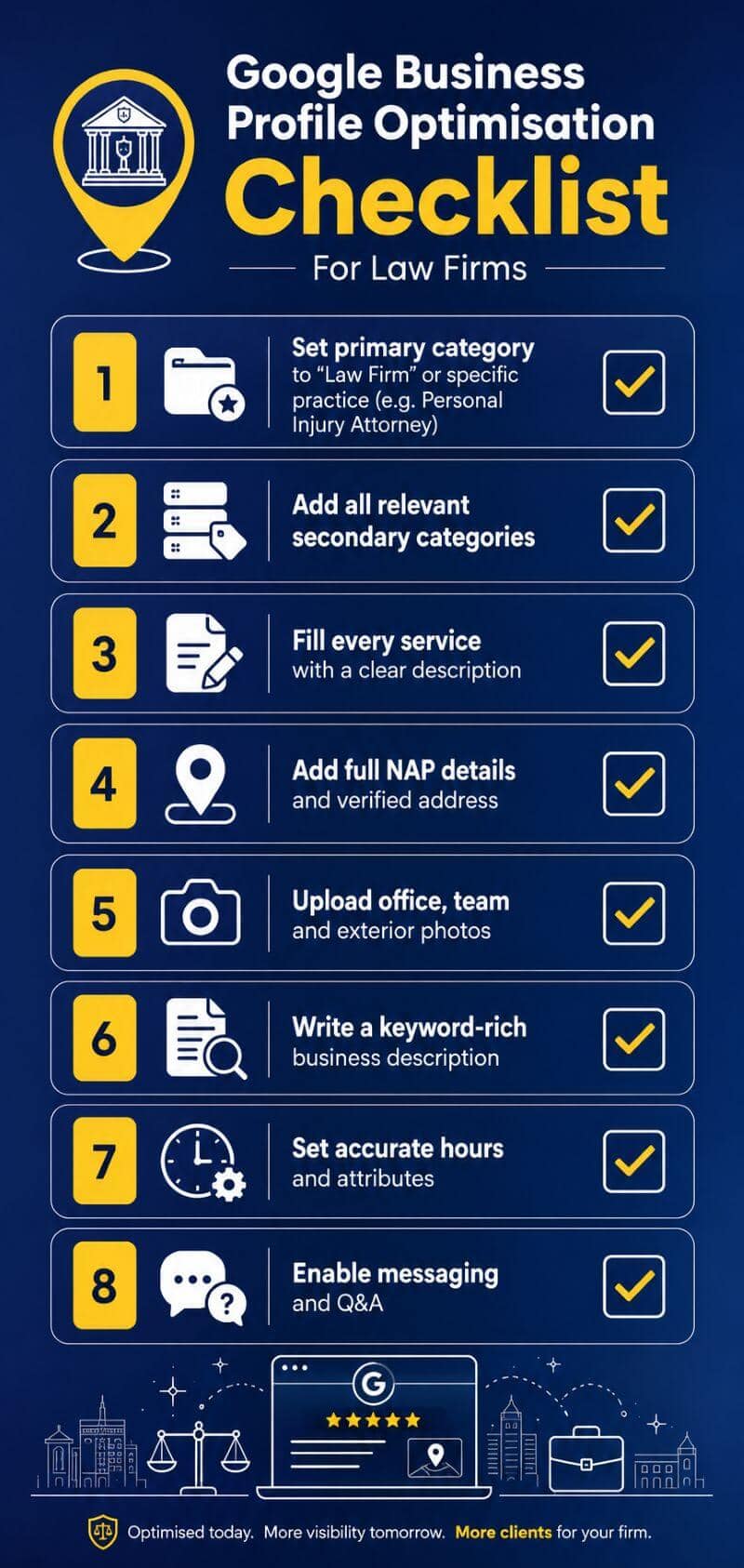
Here’s the Google Business Profile optimisation checklist for law firms:
- Ensure Your NAP Data Is Correct – Your Name, Address and Phone Number must be identical across every platform your firm appears on.
- Write Your Business Description – Use all 750 characters to explain your practice areas and what makes your firm different while naturally including relevant keywords.
- Choose The Correct Categories – Your primary category should typically be “Law Firm” and add as many secondary categories as you can, such as “Personal Injury Attorney”, “Family Law Attorney” or “Criminal Justice Attorney”.
- List All Services – List ALL legal services you offer under the relevant categories.
- Add High-Quality Photos – Add professional photos of your office, reception area, meeting rooms and your legal team.
- Enable Messages – Make it easy for potential clients to contact your firm directly and show Google you’re active.
- Add Opening Hours – Add and keep your office hours accurate.
- Create A Q&A Section – Write the most common questions potential clients ask and answer them accurately.
The most important thing is that you fill out every possible field. Think of it like free online real estate…
The more information you provide, the more visible you will be. That’s the goal at the end of the day.
There are a couple of key sections that are particularly important for law firms.
The first is categories.
Google Business Profiles allow you to add 1 primary category and up to 9 additional secondary categories. Your goal should be to fill them all out.
In most cases, “Law Firm” should be your primary category but it depends on exactly what you focus on.
Then add as many secondary categories as possible.
The second is services.
Under each category, you have an option to add the specific services you offer. Add at least 5-6 under each category.
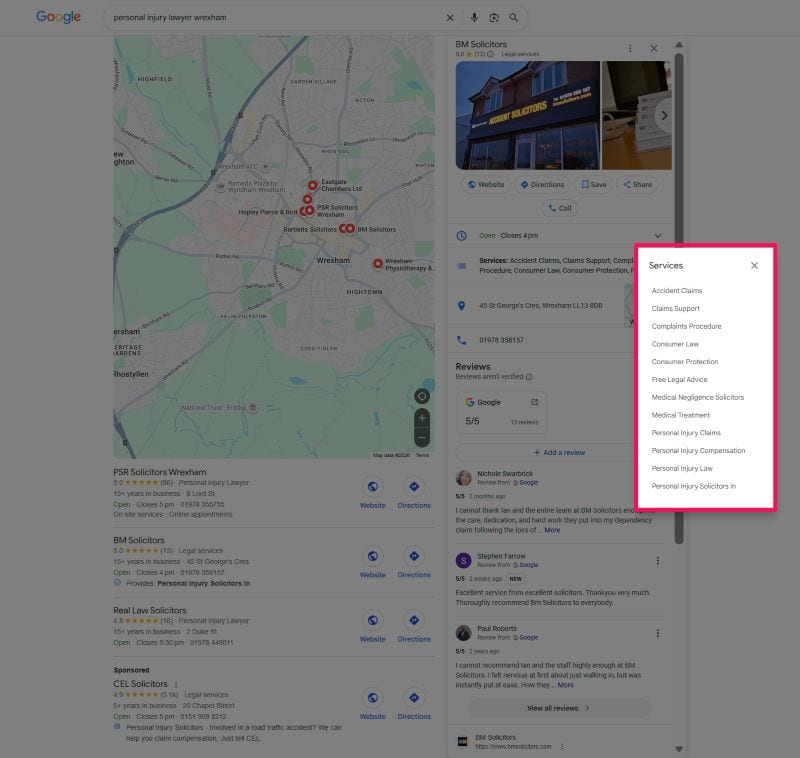
This gives Google a ton of information about your firm. It also makes it easy to recommend your business in AI answers.
Get these two things right, and you’ve already won half the battle.
2. Post Regular Updates On Your Profile
Most law firms claim their Google Business Profile and never touch it again.
But Google rewards active profiles with higher rankings.
How do you show you’re active?
Short answer: Posting updates.
Think of updates like Google’s version of social media. You can create posts that are added to your Google Business Profile.
Potential clients will see them when they’re looking at your profile.
Posting regular updates is a great way to prove to Google that your firm is active and engaged with your local community. Most of your competitors aren’t going to bother.
It’s a simple but powerful way to gain a competitive advantage and ultimately rank higher.
The most common thing I hear from law firms is:
“I don’t have time to post updates.”
The good news is that you don’t need to post every day. One relevant update per week is more than enough.
And smart law firms use a tool like RecurPost to schedule three months of posts in one sitting.
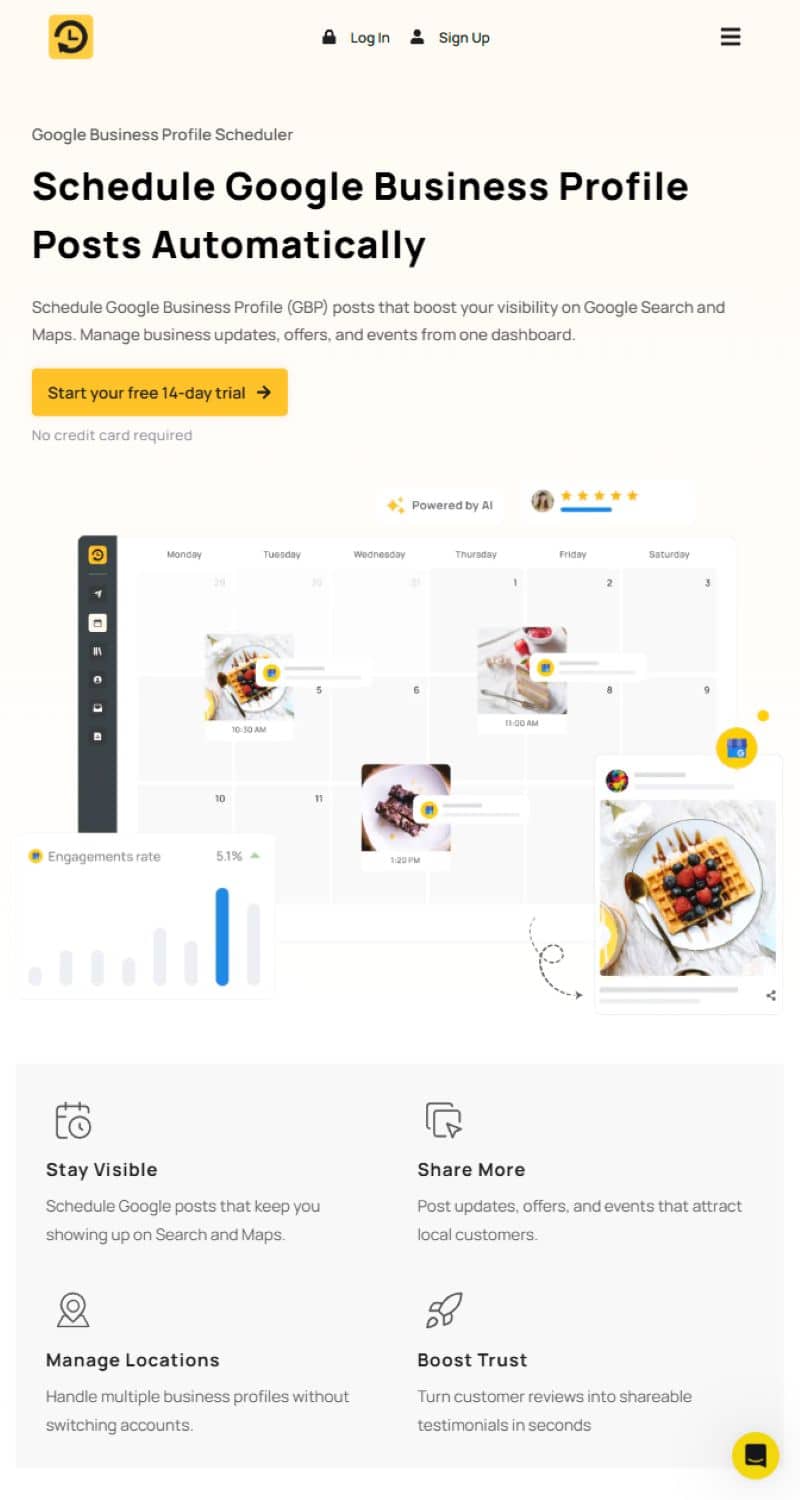
All you have to do is log in once per quarter and batch everything at once. The tool does the rest by automatically publishing a post each week.
Not so hard, right?
Here’s what to post:
- Positive case results
- Legal tips
- Events you’re involved in
- Sponsorships
- Team highlights
- Relevant legal news
- Client testimonials and reviews
Use ChatGPT to help you brainstorm ideas if you’re stuck.
Here’s the prompt:
"Write 20 short Google Business Profile post ideas for a [practice area] law firm in [city] for my law firm [website here]"
That’s over 3 months of posts ready to go in a matter of seconds. Now all you have to do is schedule, and you’re done.
Don’t overthink it.
You’re not trying to build a massive following. You just need to make sure you’re posting consistently to show Google and your target audience that you’re active.
3. Get Reviews Consistently
Reviews will make or break your local SEO.
98% of potential clients read online reviews before deciding whether to hire an attorney or not.
53% of people don’t even consider a law firm with a less than 4-star Google rating.
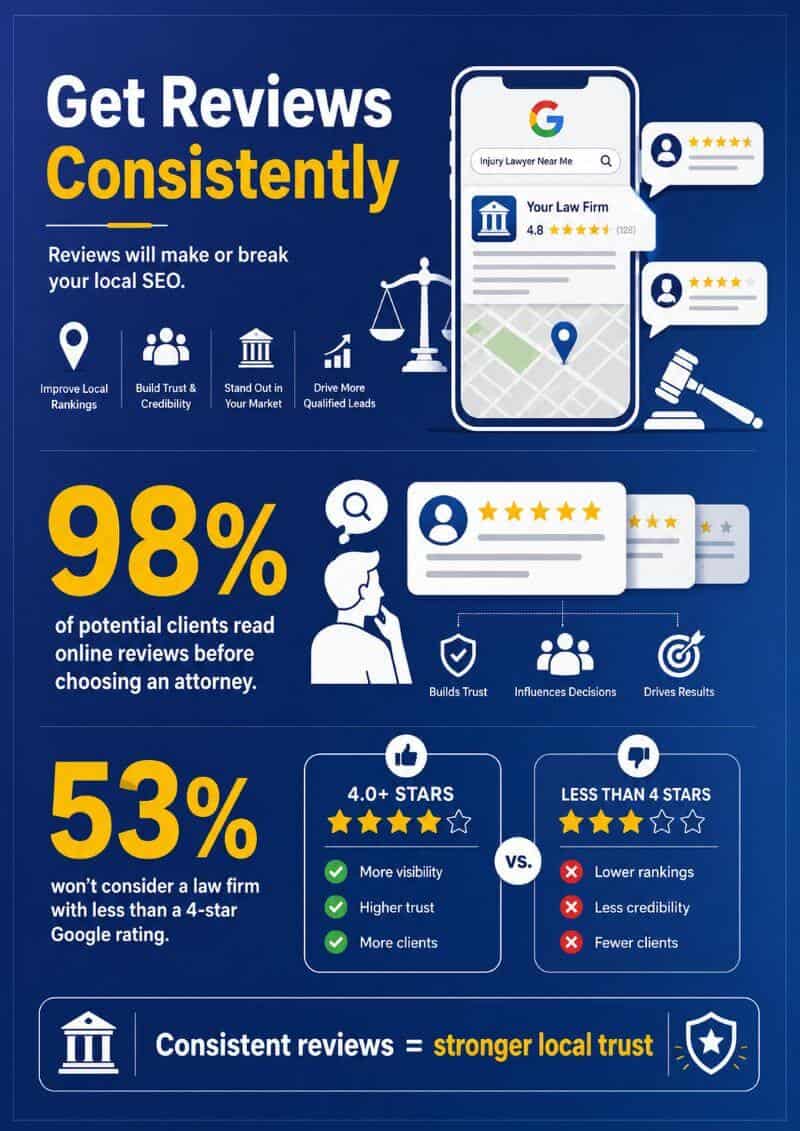
Google reviews are not just a ranking factor.
Clients actively check reviews before deciding on an attorney to hire.
And Google also treats them like endorsements for your business. The more endorsements you have, the higher you will rank.
Think about it…
How does Google really know whether your law firm offers good services?
Short answer: Reviews.
Reviews are one of the few reliable sources where Google gets to see real feedback from real people about your firm.
That’s why they lean so heavily on them.
And it goes beyond Google too.
AI tools like ChatGPT, Perplexity and Gemini also heavily rely on reviews when recommending law firms in their answers.
The bottom line is that getting reviews is essential for all areas of your business.
But what most law firms don’t realise is that Google reviews are actually an opportunity.
Here’s what I mean:
Most of your competitors can’t be bothered to get reviews. By adding regular reviews consistently, you create a massive gap between your business and your competitors. It has a positive compounding effect on your SEO that makes it hard for competitors to catch up.
With that in mind…
What’s the best way to get reviews for law firms?
Use a review acquisition tool like BrightLocal to automate the entire process.

Whenever you finish working with a client, BrightLocal will automatically send a review request by SMS or email with a direct link to your Google review page.
All they have to do is click the link and leave a review.
Simple, right?
Here’s the sequence we recommend:
• First request: Within 24 hours after finishing the work on their case
• First follow-up: 3 days after the first request was made
• Second follow-up: 7 days after the first request was made
We’ve found that 3 requests across 7 days yield the best results without annoying the client. The key is to make it easy for them to leave a review and keep the message short, but personalised.
After you start collecting reviews, you must respond to every single review within 24 hours.
Regardless of whether it was positive or negative.
Google tracks response rates and rewards firms that respond quickly.
Use a free Chrome extension like AI Review Reply Response Generator to make replies super easy.
It takes just a few seconds and keeps your response rate high without eating into your day.
Pro Tip: Build your presence on other relevant platforms like FindLaw and Lawyers.com as well. These are the directories that AI tools like ChatGPT, Perplexity and Gemini pull from when recommending law firms in their answers.
BrightLocal has direct integrations to collect reviews from these sites.

Create Content That Ranks And Converts Clients
The biggest content mistake law firms make is targeting broad competitive keywords and wondering why they don’t rank.
That’s thinking about it the wrong way.
You’re competing against national directories and law firms with millions of dollars in SEO behind them. That’s not a battle you’re going to win.
What’s the right approach?
Target locally focused, specific keywords that your ideal clients are searching for in your area right now.
Put yourself in your target audience’s shoes.
Create content that answers their most pressing legal questions and builds trust. Your goal is to position your firm as the obvious choice before they even pick up the phone.
Here are some examples of keywords:
Don't target: "personal injury lawyer"
Instead target: "personal injury lawyer in [city]"

Don't target: "car accident attorney"
Instead target: "what to do after a car accident in [state]"
See the difference?
The first puts you up against national companies with massive budgets and marketing teams.
The second puts you directly in front of a local client who needs help right now.
And local-focused search terms are easier to rank for and more likely to be surfaced in AI search answers.
Think about it like this…
Every piece of content you publish on your site is like another open door into your law firm. The more doors you have, the more clients walk through.
89% of law firms consider content very important to their overall marketing strategy.
And law firms with active blogs generate 68% more qualified leads than those without.
The key is to know what types of content will bring clients right to your front door.
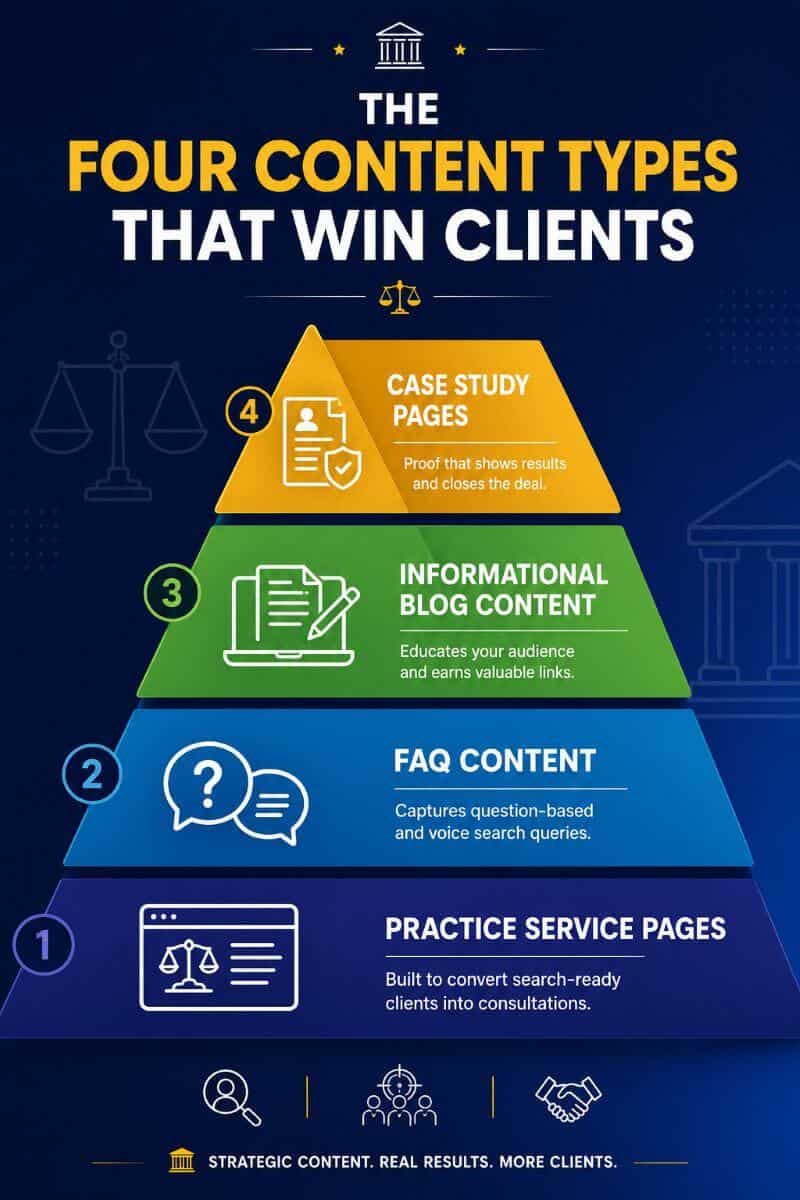
There are four types of content every law firm needs to create to rank consistently and convert visitors into clients.
1. Practice Service Pages
You need a dedicated page for every single legal service you offer.
Most law firms simply create a single page that lists all their services. Not only does this hurt your SEO, but you won’t rank on Google or get cited by LLMs like ChatGPT and Gemini.
No visibility = no leads.
If there is one content type you create for your law practice, service pages should be it.
Think of pages like:
- Personal injury [city]
- Family law [city]
- Criminal defence [city]
- Estate planning [city]
- Workers compensation [city]
Each page should target a specific practice area keyword in your city.
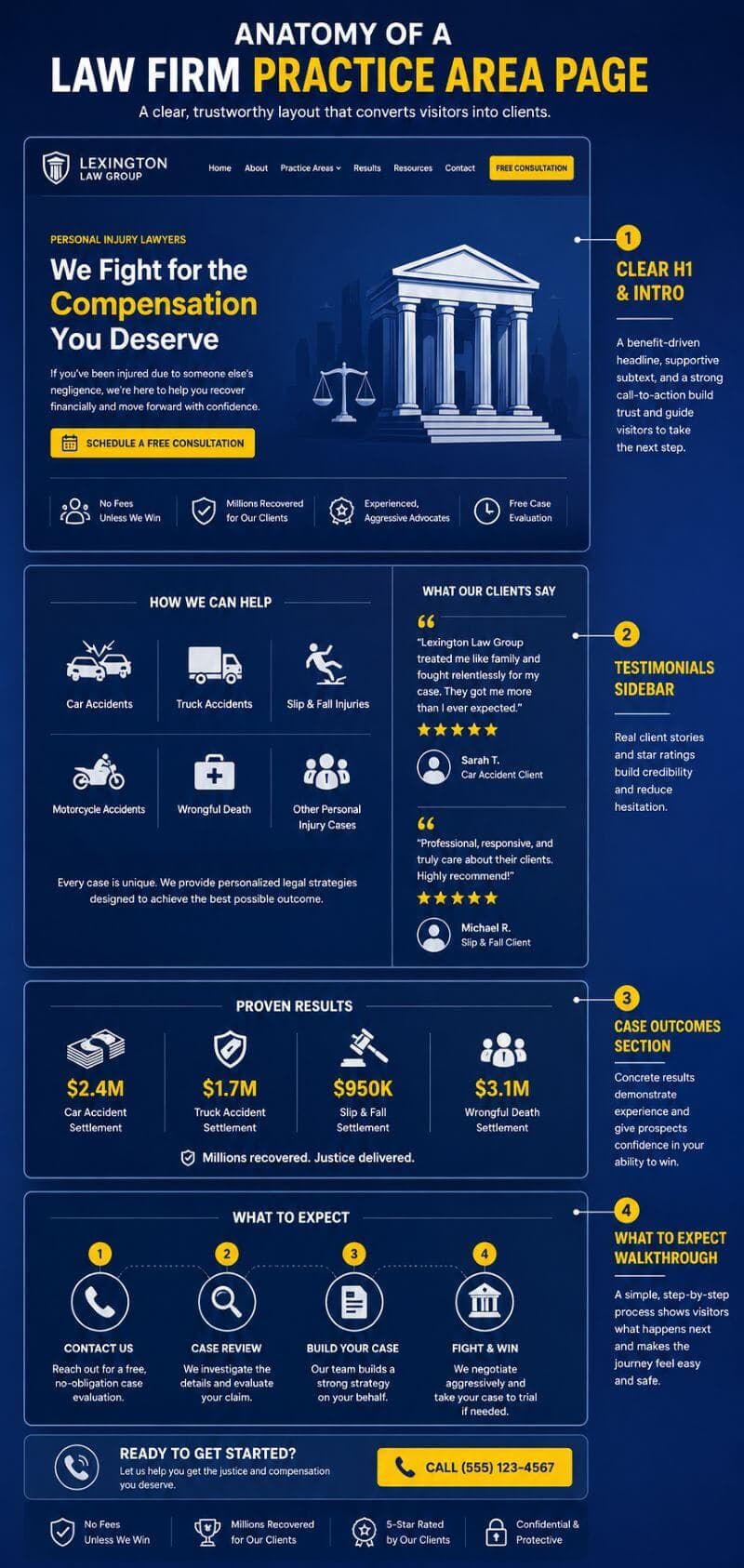
Aim for at least 800-1,000 words of unique content that answers the real questions your clients have about that service.
Don’t be too promotional.
The goal is to educate your audience and bring them into what their case would look like if you took it on.
Demonstrate to both Google and humans that you have the expertise to win cases.
Add:
- Relevant testimonials
- Mention case outcomes you’ve had
- Link to relevant case studies you’ve written
Remember:
Law is a YMYL (your money, your life) subject. That means you need to demonstrate clear E-E-A-T (Experience, Expertise, Authority, Trust) signals.
Create quality content that answers the users’ questions comprehensively. It positions your law firm as the obvious choice to move forward with, while helping your local audience.
2. FAQ Content
FAQ content is one of the most underused assets in law firm SEO.
Here’s why it works so well:
When someone has a legal problem, they don’t search traditional service-based keywords like “criminal defence lawyer.”
They search “what happens if I get a DUI in [city]?”
This is exactly the type of search that FAQ pages are designed to answer.
FAQ pages:
- Rank well in Google
- Get featured in AI Overviews
- Are cited by voice assistants like Siri and Alexa
- Are referenced in AI tools like ChatGPT and Perplexity
- Deliver value to target clients
It’s the one type of content that does well across every version of search. You can even take the questions and turn them into Reels and TikTok videos.
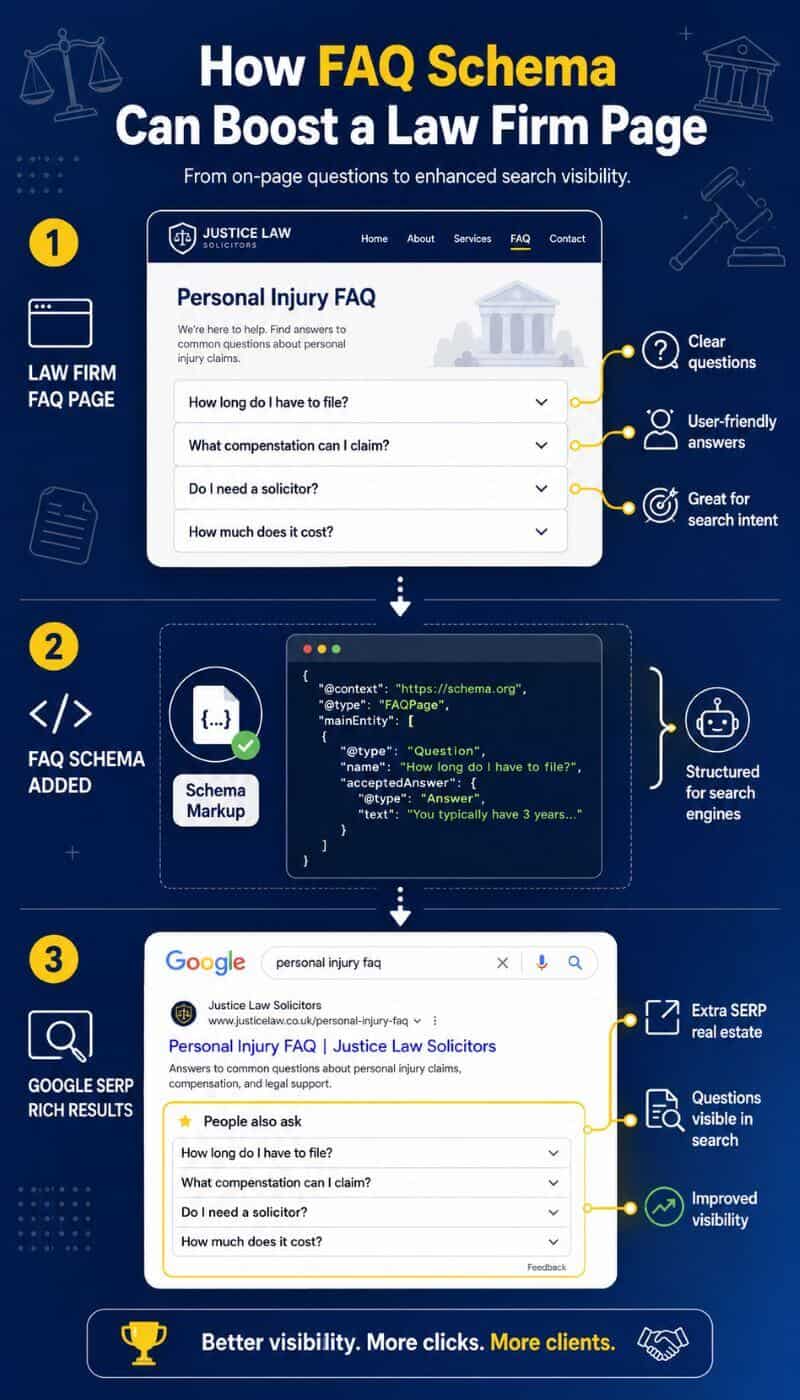
Now you can see why we recommend that every law firm create a quality FAQ page.
How do you write a FAQ page?
The first step is to make a list of common questions your target audience frequently asks.
The key is to make them specific and local.
Use this prompt in ChatGPT:
"I run a [practice area] law firm in [city, state]. List 25 frequently asked questions my potential local clients search for online. Write them in a conversational tone, exactly as my clients would search."
Pick the most relevant ones and answer them clearly and comprehensively based on your own experience and expertise.
Don’t use AI to write the answers. Do that yourself.
AI doesn’t know your experience. It’s a great way to make your content more engaging, and only you know what will resonate with your target clients.
Pro Tip: Add FAQ schema to your FAQ page. Schema makes it easier for Google, AI tools and LLMs to understand your content, which will help you get cited in AI answers.
3. Informational Blog Content
Informational blog content is how you get in front of potential clients before they even know which law firm they want to hire.
Think about it like this…
Someone just got into a car accident. They’re stressed and not sure what the next step is.
The first thing they will do is turn to Google or an AI search like ChatGPT.
That’s why informational content is a massive opportunity. You’re meeting potential clients with answers right at the time they need help, before your competitors even get a chance.
What topics should you cover?
Start with the FAQ page you created earlier.
Look at which questions are getting the most engagement or have the highest search volume.
Those are the topics your audience cares about most.
All you have to do is turn those questions into comprehensive, in-depth informational blog posts that go much deeper than the FAQ answer ever could.
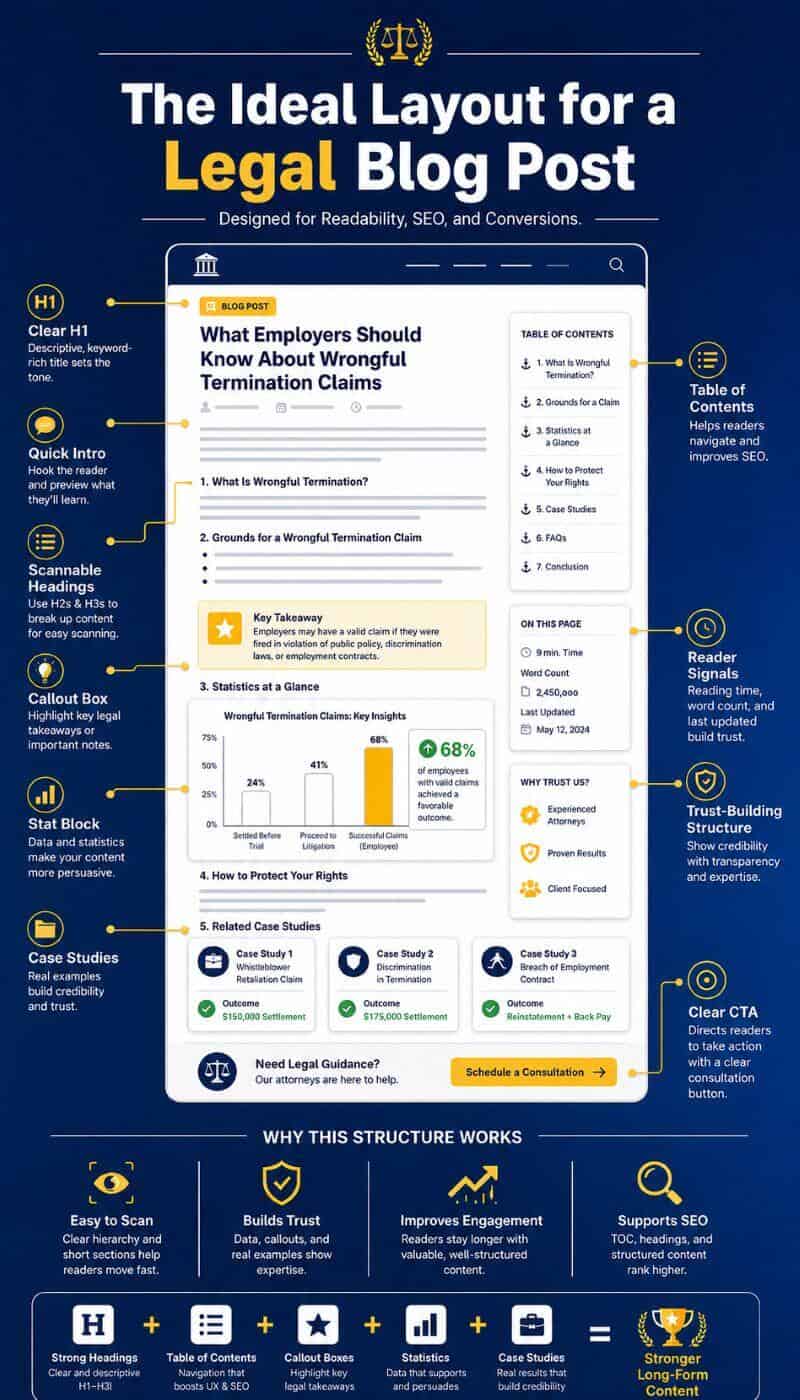
Here are some topics we’ve seen work well for law firms:
- What to do after a car accident in [city]
- How to fight a DUI charge in [state]
- What happens if you can’t afford a lawyer in [city]
- How to file for workers compensation in [state]
- What are my rights if I was wrongfully terminated in [city]
Every single one is locally focused, answers a specific question and targets a potential client in a moment of need.
Don’t just answer the question at the surface level.
Walk them through the real scenarios:
- What if the other driver has no insurance?
- What if there were no witnesses?
- What if it happened in a work zone?
That’s the content that feels real. It builds trust and converts readers into clients.
A question I get asked all the time…
“Can I just use AI to write it?”
Short answer: No.
AI is great for research, creating drafts and even helping with outlines.
But AI can only write generic information. It might read well, but it’s still generic. And any other law firm using AI to write content will essentially have the same content.
Is that what you really want on your site?
Google and AI search tools are flooded with sloppy AI content at the moment. That’s why they’ve changed their systems to identify unique content, written from real experience, with real cases and real data.
That’s something that AI simply can’t replicate.
And the effort is worth it.
Content that’s over 3,000 words gets 3x more traffic, 4x more shares and 3.5x more backlinks.
Write content that covers the topic comprehensively and is genuinely useful.
It’s how you’re going to beat competitors, rank higher and convert more clients.
4. Case Study Pages
Case studies are a powerful marketing tool for law firms.
When a potential client is considering a law firm, they only want to know one thing…
Can you actually win their case?
A case study answers that question better than any sales copy ever will.
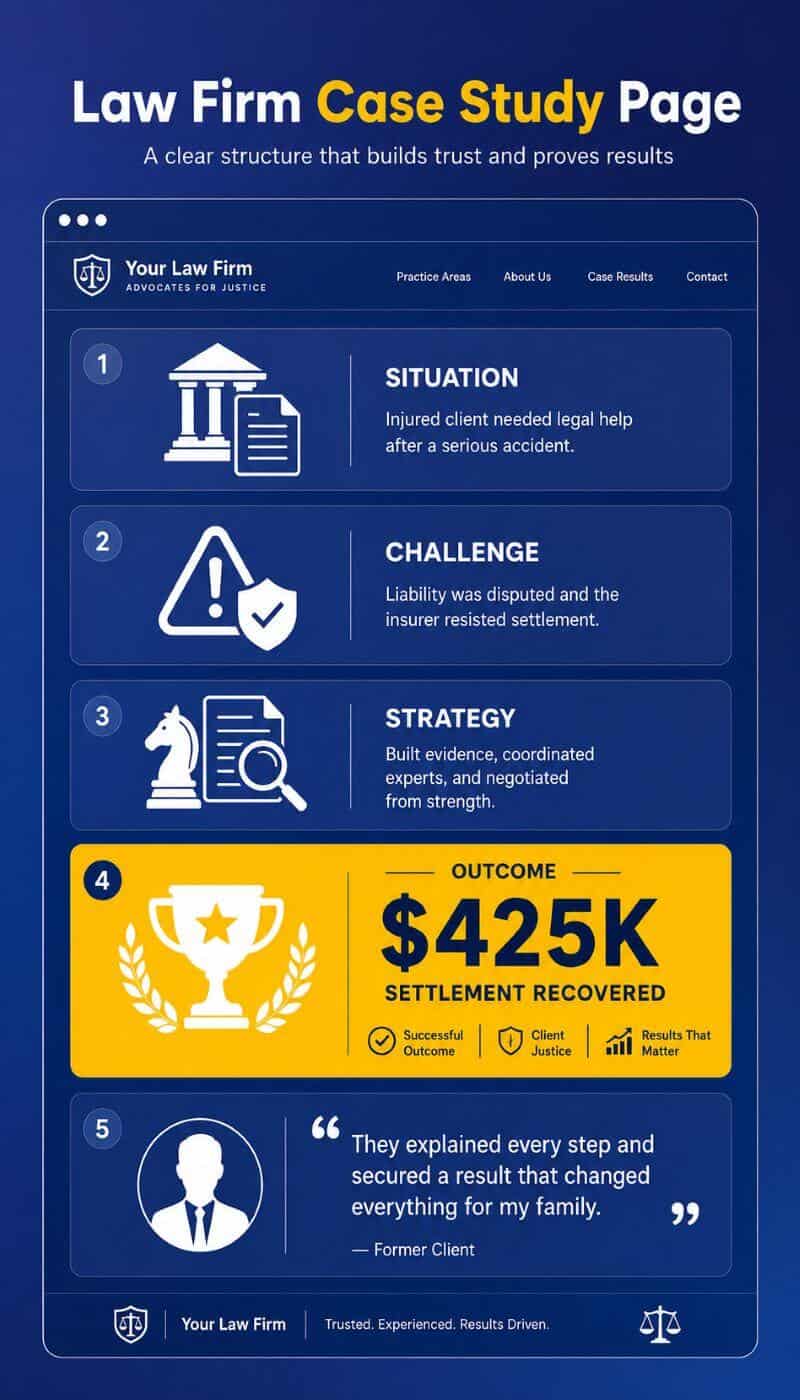
Aim to write one solid case study per quarter. Relevant and recent case studies are what win more clients.
Use this structure to write them:
- The situation: What was the client’s problem when they came to you?
- The challenge: What made the case difficult or complex?
- The strategy: How did your firm handle it?
- The outcome: What was the result you accomplished for the client?
- A client testimonial: A direct quote or video testimonial from the client
Note: Always ensure case studies comply with the state bar rules and attorney advertising before publishing.
Not so hard, right?
This simple structure is all it takes to create powerful case studies that showcase your firm’s abilities.
Pro Tip: Link to relevant case studies directly from your service pages, informational blog posts and FAQ page when relevant. This helps push potential clients further down the sales funnel and ultimately generate more leads.

Building SEO Authority With Backlinks
You can have a completely optimised Google Business Profile and excellent content.
But the truth is that without quality backlinks…
Your site will struggle to rank.
Let me explain:
Google and LLMs want to know that they can trust your law firm before they rank and source your content.
The biggest factor they use to determine whether they can trust your site is backlinks.
Think of a backlink as a vote of confidence in your law firm. The more links (votes) you have from other trusted and relevant websites, the more authority you have.
More authority = higher Google rankings and more AI citations.
Who doesn’t want that, right?
Backlinks are like the fuel to your SEO fire.
They significantly affect your rankings on:
- Traditional Google search
- AI search tools like ChatGPT and Perplexity
- Local map pack
It’s the one SEO strategy that will help your law firm show up in the 3 core places your potential clients are actively searching.
That’s why backlinks are so powerful.
But that’s not all…
Most law firms spend all their time creating content but neglect to build backlinks. That’s your opportunity.
94% of all online content doesn’t have backlinks. The vast majority of your competitors don’t build backlinks.
That means backlinks can become a competitive advantage for your firm. They act as a moat around your business that is hard to replicate.
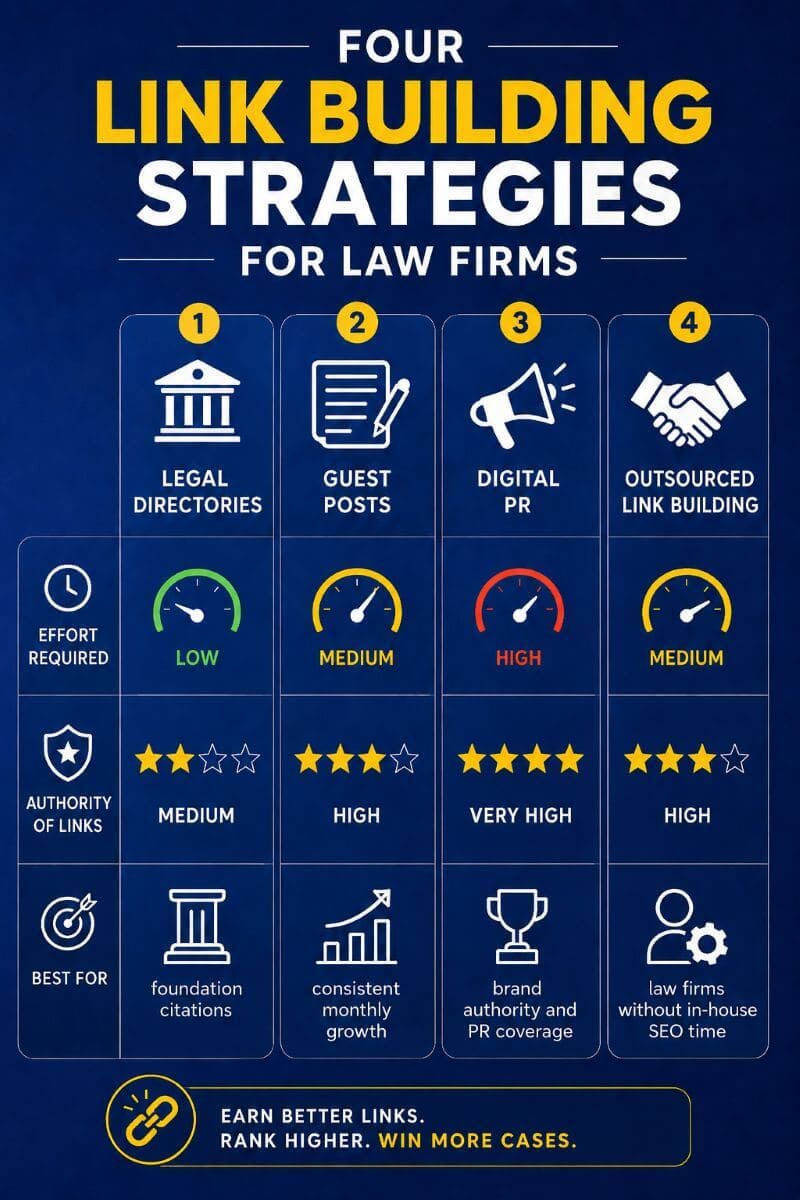
The key is to know what specific strategies earn the best backlinks. These are the three best strategies to build quality links for law firms.
1. Trusted Business And Legal Directories
Directories are the easiest and fastest way to start building backlinks for your law firm.
And Google basically expects that any reputable law firm would be listed on them.
There are two types of directories worth building links on right now…
Legal Specific Directories:
- Avvo
- FindLaw
- Justia
- Lawyers.com
- Super Lawyers
- Martindale-Hubbell
Local Business Directories:
- Chamber of Commerce
- Better Business Bureau (BBB)
- Local bar associations
- Yelp
- Apple Maps
- Bing Places
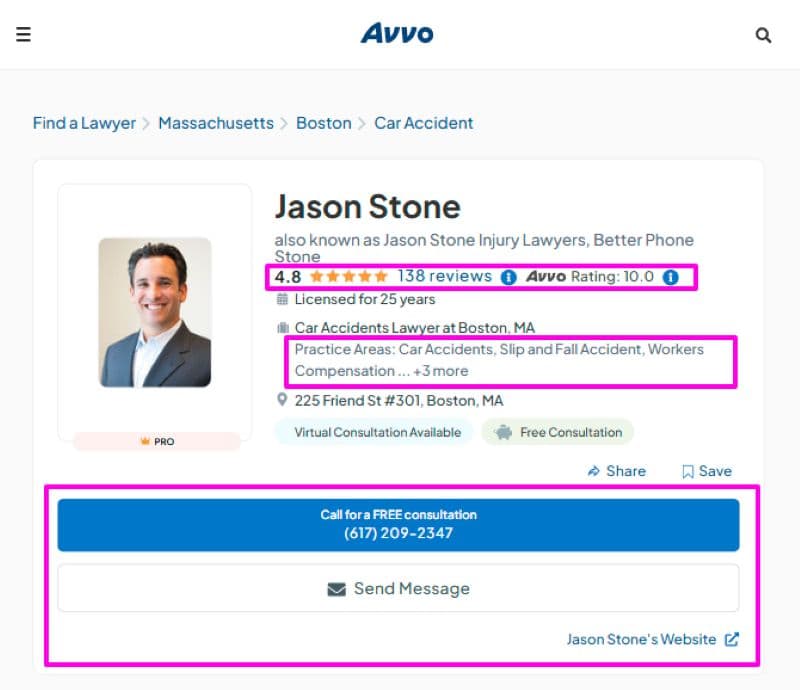
You want your law firm listed on all of these places. These directories are already trusted by Google.
Getting listed sends a strong authority signal and puts your firm in front of potential clients actively searching for legal help.
But there is one massive benefit to being listed on all of them.
AI tools like ChatGPT, Perplexity and Gemini also trust them.
Ask ChatGPT what the best law firms in your city are, and look specifically at the sources.
This is where ChatGPT is pulling its information from.
More often than not, you’ll see that directories are part of those sources. At the very least, they will be part of the AI training data. Building links on each of these directories increases the chance that your law firm will be recommended in the answers.
That’s a powerful strategy that will immediately boost your authority and SEO results.
Pro Tip: Make sure that your NAP data (Name, Address and Phone Number) is EXACTLY the same on all directories. This will ensure that each directory listing strengthens your local map pack rankings.
2. Guest Posts On Legal Blogs
Guest posts are a proven link building strategy for law firms and attorneys.
It’s one of the best ways to build quality links on relevant sites and have full control of how your brand is positioned.
Here’s how it works:
You write a high-quality piece of content for a highly relevant, authoritative website. Relevant means a legal website or a site that regularly publishes quality legal-focused content.
In return for the content, you get a backlink.
Simple, right?
The most important aspect of guest posts is quality.
A quality guest post is from websites that:
- Are high authority sites
- Have at least 500+ monthly organic traffic
- Are relevant to the legal industry
- Have clear editorial standards
- Are genuine, real websites

Here’s the problem:
Finding quality sites and pitching guest posts is hard work.
And when you finally land one, you have to write the content, and they usually ask for a “placement fee” of $150 to $300.
Most law firms simply don’t have the time to build guest post links consistently.
That’s why so many law firms and even SEO agencies choose to outsource link building to a trusted service like LinksThatRank.

Every guest post link we build goes through a strict 23-point quality control process, so you only get links that actually improve your rankings.
Choose the links you need and tell us your target keywords.
We’ll take care of the rest.
3. Digital PR Links
Digital PR links are some of the most powerful backlinks you can build for your law firm.
This strategy allows you to get backlinks from major publications you’d never otherwise have access to.
And it’s often easier as a lawyer than for professionals in other industries.
Let me explain how it works:
Journalists and reporters are often looking for legal experts to quote in their articles relating to certain issues.
If you can become the source for one of their articles, you’ll often earn a powerful authority-building backlink as well. Think of links from local news sites, industry publications and national media outlets.
These links carry serious weight with Google and AI search tools because they come from some of the most trusted websites on the internet.
Here’s how to get started…
Create a profile on each of the following platforms:
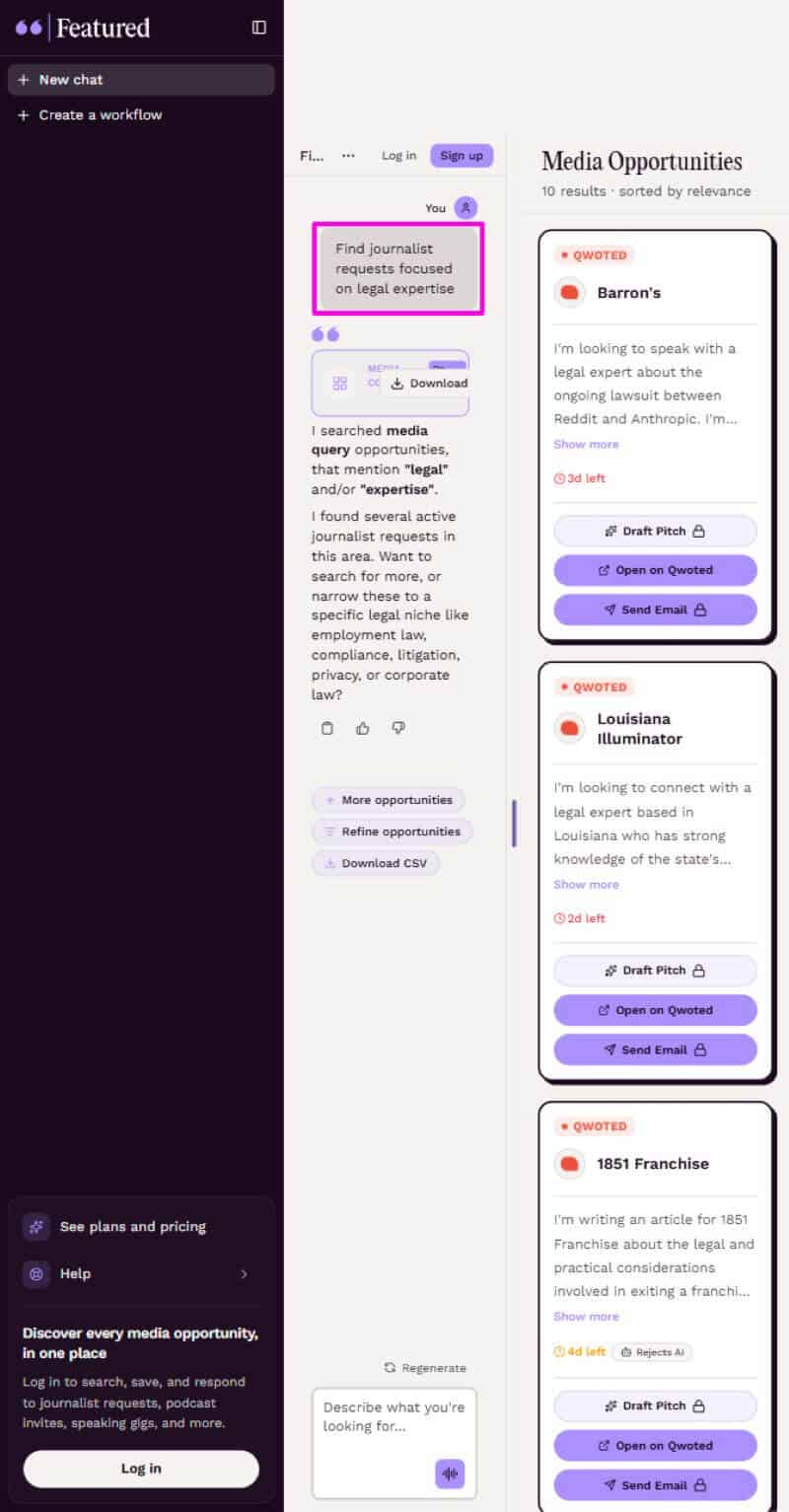
Monitor these platforms daily.
When you see a question relevant to your expertise, reply with a well-structured, comprehensive answer that provides the journalist with what they need.
If they use your quote or answer in their article, they’ll often link to your law firm website as the source.
That’s exactly what you want.
This strategy is one of the best ways to get backlinks from major publishers like The New York Times, Forbes and The Guardian.
It’s one of the best ways to build powerful backlinks that increase Google rankings, AI search citations and local map pack rankings.
4. Outsource To A Trusted Link Building Service
Don’t have time to build links yourself?
This is where most law firms fall short.
And it makes sense. Your time is worth more working with clients than it is manually building backlinks for your site.
That’s why outsourcing makes sense.
LinksThatRank specialises in building quality backlinks for law firms that actually move rankings and increase AI mentions.
Every link we build is:
- Naturally built to strict white hat SEO standards
- Placed on a real site trusted by Google
- Guaranteed to be on a site with at least 500+ monthly organic traffic
- Checked against our backlink blacklist database of over 60,000+ domains
- Passes our strict 23-point quality control process
- Placed with 1,000+ words of quality human-verified written content
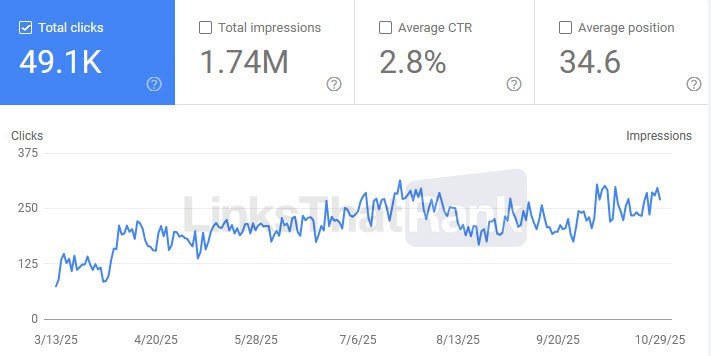
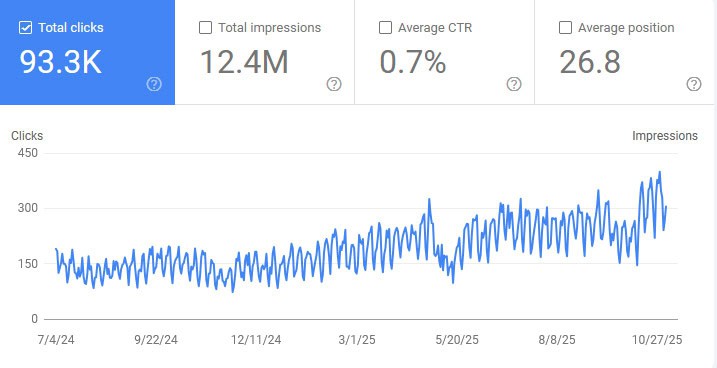
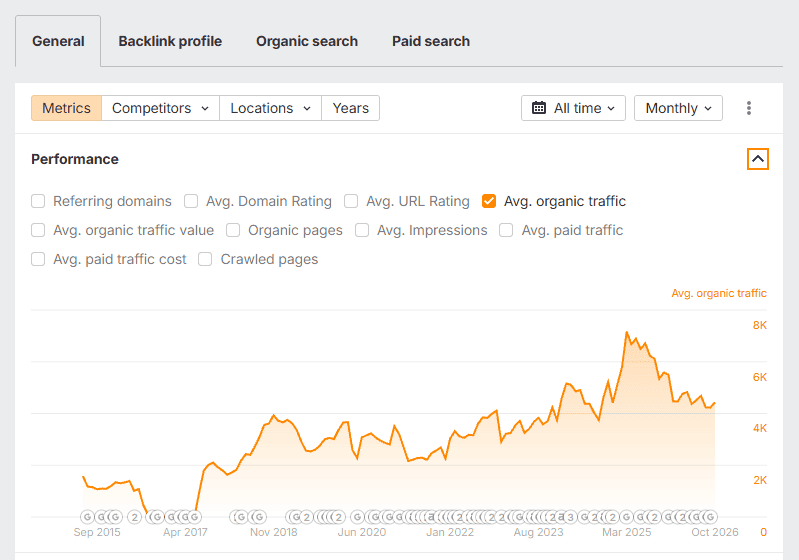
That’s why our links consistently deliver results like this for clients:

The best part?
There are:
• No minimums
• No lock-in contracts
• No long-term agreements
Just quality backlinks proven to deliver the results you need.
Choose your links now, tell us your target keywords, and let our team handle the rest. You’ll receive your shiny new links within 14-25 days.

Recommended Tool Stack for Law Firm SEO
If you’re going to do SEO, there are some tools you’ll need.
The good news is that you don’t need every SEO tool available to accomplish good results.
Here are some essential free and paid SEO tools that we recommend to our own law firm clients.
Paid Tools:
• Ahrefs - Best SEO tool for backlink analysis, tracking new links earned and competitor research
• Semrush - Good alternative to Ahrefs for keyword research and tracking your backlink profile
• BrightLocal - A powerful local SEO tool to help you optimise your Google Business Profile and track your local rankings
Free Tools:
• Google Business Profile - Essential for local visibility, ranking in the map pack and appearing for local searches online
• Google Search Console - A must-have free tool to track your website performance in the Google search results
• Backlink Blacklist - Check each link you're building to ensure they aren't PBNs, link farms or spam sites
Wrapping It Up
Attorney SEO is one of the best marketing investments your law firm can make.
But the firms sitting at the top of Google and getting recommended by AI search tools like ChatGPT and Perplexity aren’t there by accident.
They’re using a proven SEO strategy and consistently building backlinks.
Start by optimising your Google Business Profile and collecting online reviews. It takes less than 30 minutes to set everything up and is the biggest quick win for attorney SEO.
Then implement the content strategy and start building high-quality backlinks to increase your website’s authority.
This will allow you to dominate the local search results and get recommended by AI consistently.
Remember:
Building quality backlinks will accelerate your SEO growth and give you a distinct competitive advantage. It’s one strategy that your competitors can’t easily copy and it compounds over time.
Don’t have time to build the backlinks?
Let our specialist link building team at LinksThatRank take care of it for you. We’ll build the quality backlinks you need to outrank competitors and get recommended by AI tools.
- Guest Posts – High-quality AI search-ready
- Link Building Packages – Discounted monthly bundles
- Link Inserts – Niche-relevant editorial placements
- Agency Program – Discounted white label services
Frequently Asked Questions
How long does SEO take to work for law firms?
SEO for law firms typically takes 6 to 12 months to see meaningful results. Most law firms see initial results from SEO within 3-6 months. Just by optimising your Google Business Profile and getting more reviews, it’s possible to see local SEO results within 4-8 weeks.
How much should a law firm spend on SEO?
Law firms should typically expect to invest between $2,500 and $10,000+ per month on SEO. The amount spent depends on the market competition, target keywords and scope of the campaign. It’s not uncommon for law firms to invest between 2% and 6% of gross annual revenue.
Is SEO better than PPC for law firms?
Neither SEO nor PPC is strictly better for law firms. Both have different purposes and goals. SEO is typically considered the best for long-term growth because legal keywords average $142 per click with Google Ads. But SEO takes longer to work, whereas PPC can generate leads immediately.
Do backlinks really matter for attorney SEO?
Yes, backlinks are essential for attorney SEO and remain one of the top ranking factors. Backlinks are estimated to make up to 15% of total rankings. They signal authority and trust to both Google and AI search tools like ChatGPT, Gemini and Perplexity.